
Books ›
c. 1002 · Kyoto
The Pillow Book
A thousand years ago, a woman at the Japanese court wrote down everything she loved. We still have the notebook.
How this book came to be
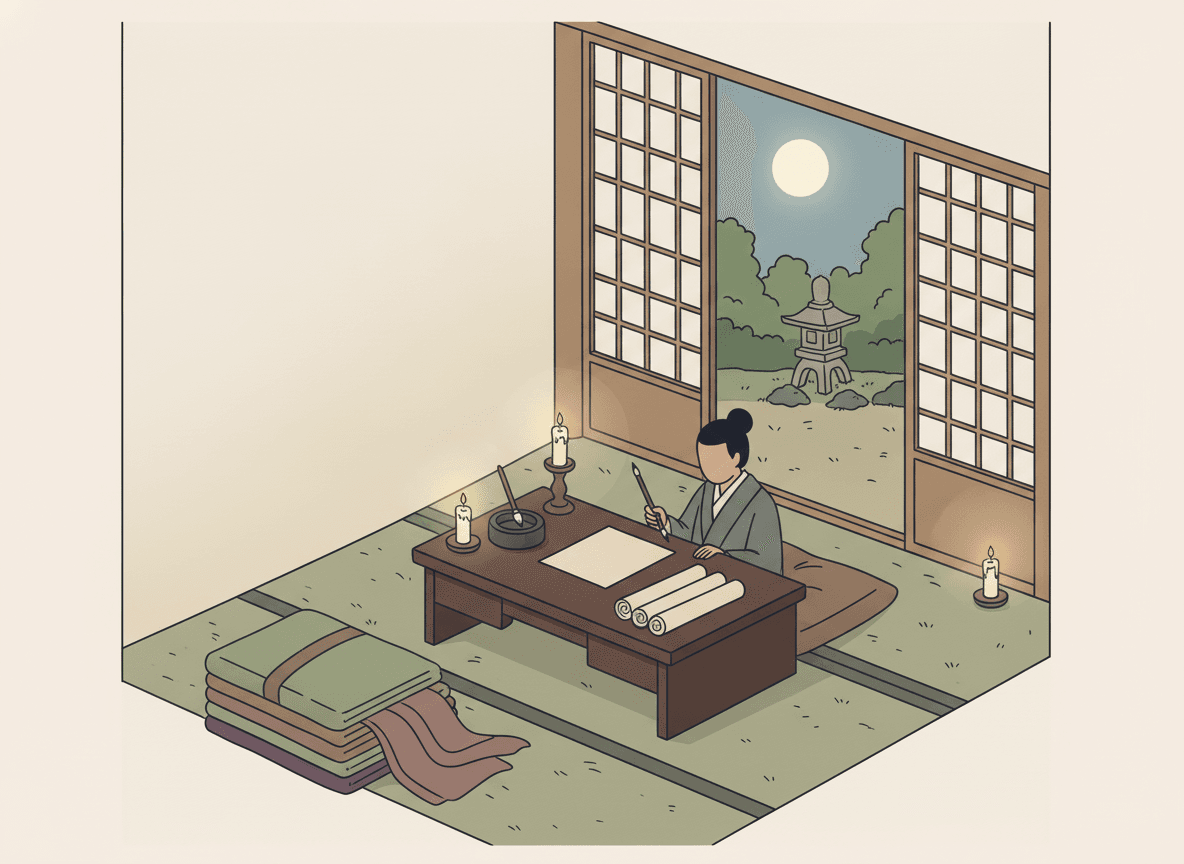
Around the year 1000, a woman known to us as Sei Shōnagon served in the household of Empress Teishi at the Heian court in Kyoto, then called Heian-kyō. She was a lady-in-waiting, which meant she lived inside the palace, close to the empress, in a world of screens, curtains and layered silk robes. Court life ran on manners so precise that a wrong shade of paper or a late reply could damage a reputation. Sei Shōnagon watched all of it, and she wrote it down.
The Pillow Book is not a novel. It is a collection of observations, opinions, anecdotes and lists, several hundred loosely joined passages, some a page long and some a single line. Famous sections simply catalogue things: elegant things, annoying things, things that make the heart beat faster.
The book tells its own origin story. According to a passage in the text, the empress was given a bundle of fine paper, and Sei Shōnagon asked to have it. The title has been read as meaning notes kept near one's pillow, private and off duty, though the exact sense is debated. She claims she wrote for herself and that the pages escaped into the world without her wanting it. Scholars treat that modesty as a convention as much as a fact.
The timing matters. Teishi's family lost its grip on power to a rival branch of the Fujiwara clan, and the empress died in childbirth in 1001, on a lunar-calendar date falling at the very end of 1000. Yet the book keeps the court sunlit and witty, which many readers take as deliberate loyalty to a world already slipping away.
No original manuscript survives. The text reached us through hand-copied versions that differ in order and content, so no one can be certain what she wrote or when. Even so, it became a foundation of Japanese prose and named a whole genre, zuihitsu, meaning "following the brush": writing that wanders wherever attention goes. Modern list-making, diary blogging and essay writing all have an ancestor in a woman with good paper and sharper opinions.
Continue in the app
Open the app for the illustrated story of this book and the world it was written in. The book itself is not included: it is still in copyright, so read it on Kindle or import your own EPUB into the app's library.
- ✓ The illustrated story of the book
- ✓ The world it was written in, on the map and timeline
- ✕ The full text is not included (in copyright)
Illustrations are created with AI assistance. Summaries are written with AI and reviewed by the editor. Book metadata comes from Wikidata and Open Library.