
Books ›
1884 · Mississippi River
Adventures of Huckleberry Finn
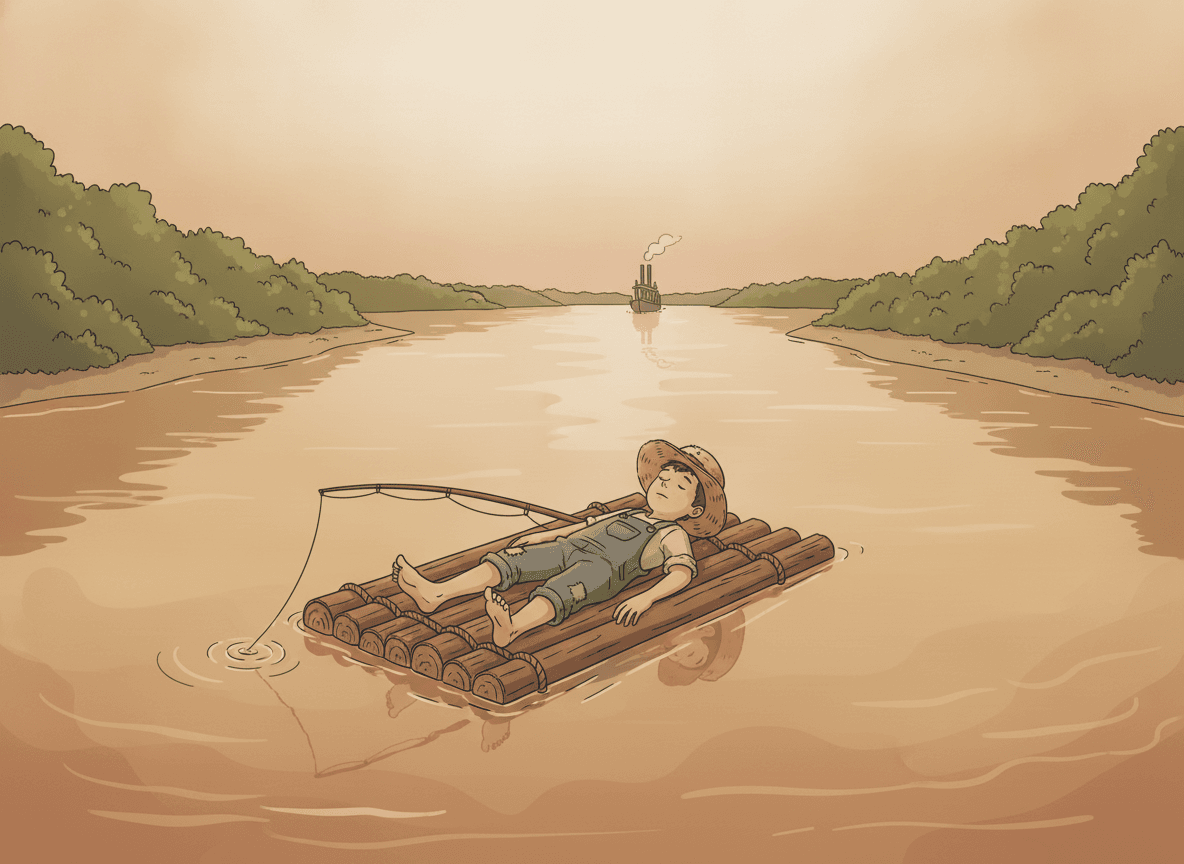
Huck Finn runs from everyone who wants to own him, and finds a friend on the Mississippi.
How this book came to be
In the summer of 1876, Mark Twain was sitting in a small octagonal study on a hilltop at Quarry Farm, near Elmira, New York. His name was really Samuel Clemens, and he had been a steamboat pilot on the Mississippi River before he was a writer. He had just finished Tom Sawyer, and he started a companion book narrated by Tom's scruffy friend Huck, a runaway boy who floats down the Mississippi on a raft with Jim, a man escaping slavery. That is the whole anchor you need: a boy, a river, and a friendship that the laws of his time said should not exist.
Then Twain got stuck. He wrote a few hundred pages, lost his enthusiasm, and put the manuscript in a drawer. It stayed there, on and off, for years. What restarted him was a trip: in 1882 he went back to the Mississippi he had piloted as a young man, riding steamboats and taking notes for another book, Life on the Mississippi. Seeing the river again gave him the voice and the detail he needed, and he finished Huck's story soon after.
The book came out in Britain in December 1884 and in the United States in February 1885. Trouble arrived fast. One of E. W. Kemble's engravings was tampered with by someone at the printer to look obscene, so pages had to be recalled. Then in March 1885 the public library in Concord, Massachusetts threw the book out, calling it coarse and unfit. Twain was delighted, because he knew a scandal sells copies, and he said so.
Its afterlife is enormous. Twain wrote Huck's narration in the plain, ungrammatical speech of a real boy, which broke American writing away from polished European prose. Ernest Hemingway later claimed all modern American literature came from this one book. It is also one of the most argued-over books in American schools, because Twain reproduced the racist language of the 1840s South in order to attack the racism itself, and readers still disagree about how that lands.
Continue in the app
Open the app for the illustrated story of this book, the world it was written in, and the full text, a free public-domain edition, to read on screen or hear read aloud.
- ✓ The illustrated story of the book
- ✓ The world it was written in, on the map and timeline
- ✓ The full text, free, read or read aloud
Illustrations are created with AI assistance. Summaries are written with AI and reviewed by the editor. Book metadata comes from Wikidata and Open Library.