
Books ›
29 to 19 BC · Latium
Aeneid
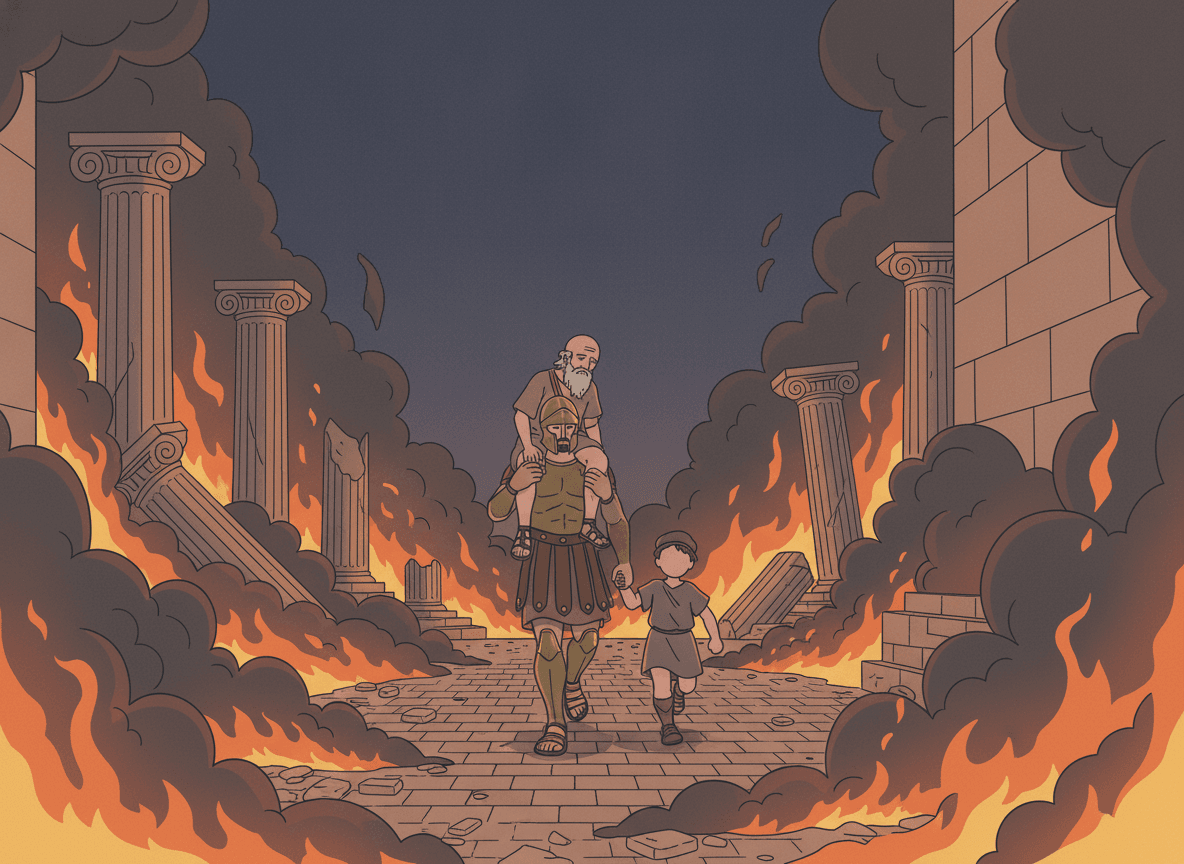
A city burns, a man carries his father out of the fire, and a whole future rides on his back.
How this book came to be
The Aeneid is a long poem in Latin about Aeneas, a Trojan prince who escapes his burning city and sails west to found the line that will become Rome. Virgil worked on it for roughly the last eleven years of his life, from about 29 BC until his death in 19 BC.
Those years matter. Rome had just come out of decades of civil war. Octavian, soon renamed Augustus, had defeated Mark Antony and Cleopatra at Actium in 31 BC and was rebuilding the state around himself. Virgil was already famous for the Eclogues and the Georgics, and he belonged to the circle around Maecenas, a wealthy patron who connected poets to Augustus. So the poem was written close to power, and it reads that way: Rome's future is prophesied inside a story set a thousand years earlier.
Virgil built it on purpose as a Roman answer to Homer, whose Iliad and Odyssey were the models every educated reader knew. The first half wanders like the Odyssey, the second half fights like the Iliad. Ancient biographers say he composed slowly, drafting in prose first and polishing only a few lines on a good day.
He never finished it. In 19 BC he traveled to Greece, planning years more revision, fell ill, and died at Brundisium on the way home. The tradition, reported by his ancient biographers, is that he asked for the manuscript to be burned and that Augustus overruled him. That story may be embroidered, but the poem clearly went out unrevised: dozens of lines still break off half-finished.
It was a school text almost immediately, which is a large part of why it survived. Roman children learned to read on it. Medieval readers treated Virgil as a near-prophet, which is why Dante made him his guide through Hell in the Divine Comedy. Translations, from Gavin Douglas in Scots to Dryden to Robert Fagles and Sarah Ruden, kept it moving. Its opening words, Arma virumque cano ("I sing of arms and a man"), are among the most quoted lines in Europe.
Continue in the app
Open the app for the illustrated story of this book, the world it was written in, and the full text, a free public-domain edition, to read on screen or hear read aloud.
- ✓ The illustrated story of the book
- ✓ The world it was written in, on the map and timeline
- ✓ The full text, free, read or read aloud
Illustrations are created with AI assistance. Summaries are written with AI and reviewed by the editor. Book metadata comes from Wikidata and Open Library.