
Books ›
c. 560 BC · Samos
Aesop's Fables
A slave, a sharp tongue, and a zoo of animals who know exactly who you are.
How this book came to be
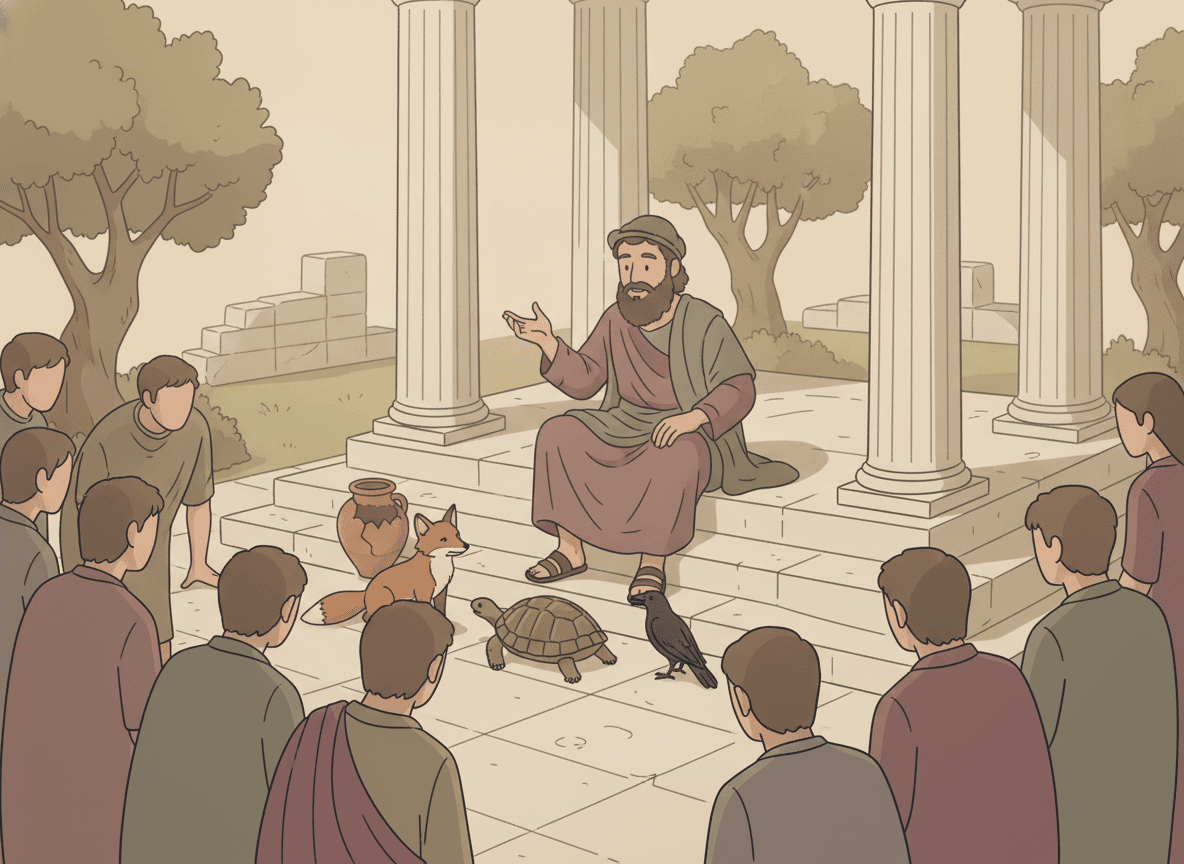
Aesop's Fables are short animal stories with a moral, the kind where a fox flatters a crow into dropping its cheese. They are the oldest stories most of us learn, and their author is barely a person at all.
What we know about Aesop is thin and mostly secondhand. Herodotus, the Greek historian writing about a century after him, calls Aesop a fable-maker who was enslaved on the island of Samos in the 6th century BC. Later Greek and Roman writers added more: that he was ugly, sharp-tongued, and clever enough to talk his way out of trouble. Tradition also says he died at Delphi, the mountain sanctuary where Greeks came to consult the oracle of Apollo. The story goes that the Delphians accused him of stealing a golden cup from the temple and threw him from a cliff. That tale may be invention, and many scholars think the whole biography grew around the stories rather than the other way round.
The fables themselves were not written by anyone in the way we mean it. They were spoken. In archaic Greece a fable was a debating tool, dropped into an argument or a lawsuit to make a point sideways, because a story about a wolf is safer than an accusation about a neighbour. Some of them are older than Greece entirely, with cousins in Mesopotamian and Near Eastern writing. Aesop's name worked as a label, so a good fable simply became one of his.
The first known collection came around 300 BC from Demetrius of Phalerum, a scholar in Athens. His book is lost. What survived came through retellings: Phaedrus put fables into Latin verse in the 1st century AD, and Babrius into Greek verse soon after. Medieval schoolrooms used them to teach Latin, which kept them copied for a thousand years.
Then printing arrived. William Caxton issued an English Aesop in 1484, among the earliest books printed in England. In 1668 the French poet Jean de La Fontaine rewrote many of them in elegant verse, and they became French national furniture. The phrases outlived the book: sour grapes, the boy who cried wolf, the tortoise and the hare. Most people quote Aesop without knowing it.
Continue in the app
Open the app for the illustrated story of this book, the world it was written in, and the full text, a free public-domain edition, to read on screen or hear read aloud.
- ✓ The illustrated story of the book
- ✓ The world it was written in, on the map and timeline
- ✓ The full text, free, read or read aloud
Illustrations are created with AI assistance. Summaries are written with AI and reviewed by the editor. Book metadata comes from Wikidata and Open Library.