
Books ›
5th century BC · Qufu
Analects
A teacher, his students, and a book of remembered talk that steered half the world.
How this book came to be
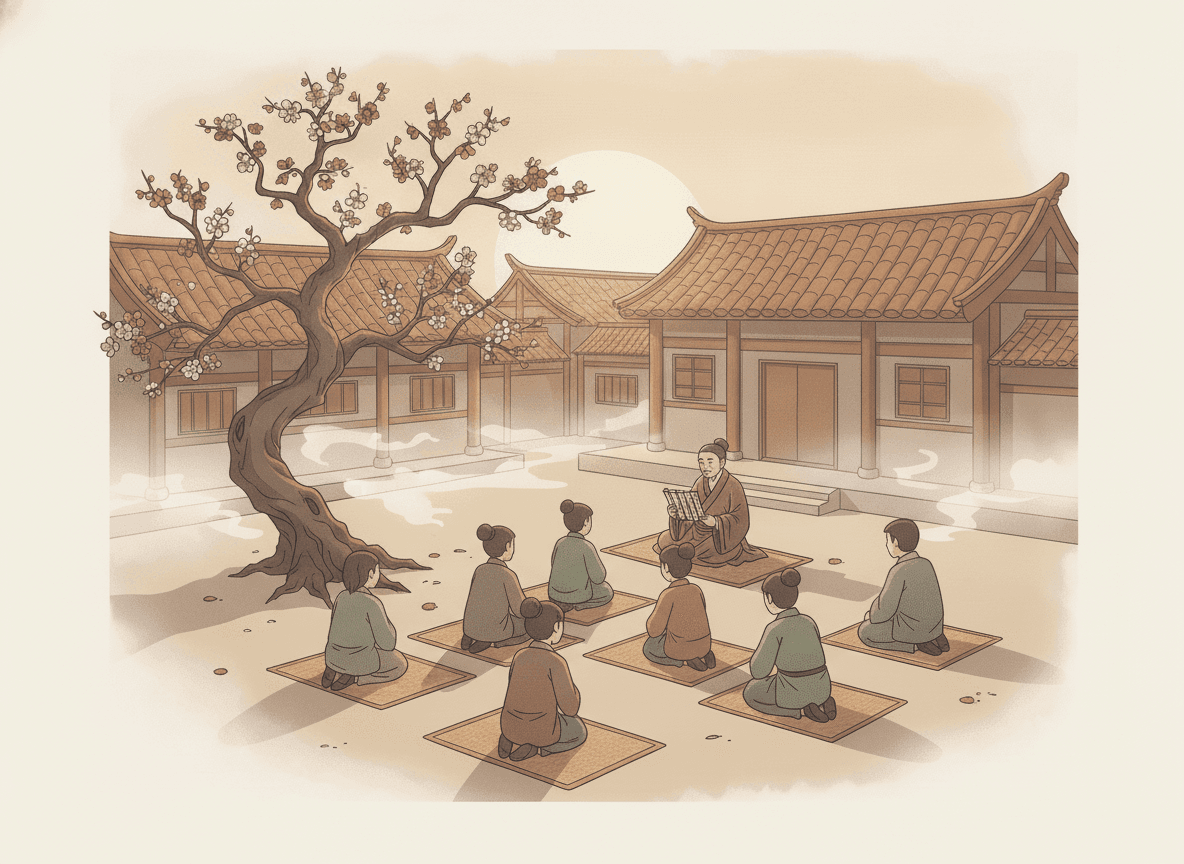
The Analects is not a book anyone sat down to write. It is a collection of short sayings, questions and exchanges attributed to Confucius, a teacher from the state of Lu in what is now Qufu, in eastern China. He lived from about 551 to 479 BC, in the late Zhou period, when the old royal order was breaking apart and rival states fought each other constantly. Confucius was not a king or a general. He held minor offices, lost them, and spent years traveling from court to court trying to persuade rulers to govern by moral example rather than force. Almost none of them listened.
What he did have was students. He taught them about ritual, family duty, learning and ren, a word usually rendered as humaneness, meaning the decency you owe other people. After his death, those students and then their students wrote down what they remembered him saying. That is why the text reads the way it does: in fragments, often beginning with the formula "The Master said." There is no argument running from start to finish. Different chapters clearly come from different hands and different generations, and scholars still debate which layers are earliest. The rough date of about 475 BC marks the era when the material began taking shape, not a publication day.
Its journey was not smooth. Under the first emperor, Qin Shi Huang, Confucian texts were suppressed in the late third century BC. They came back under the Han dynasty, which made Confucian learning the backbone of the state. For roughly two thousand years afterward, anyone who wanted a government post in China had to know this material by heart, because the imperial examinations tested it. That single fact shaped the education of millions of people.
The Analects traveled with that influence into Korea, Japan and Vietnam. Jesuit missionaries carried Latin translations to Europe in the seventeenth century, where Enlightenment thinkers found in Confucius a moral philosopher who reasoned without appealing to revelation. Today its lines are quoted in Chinese classrooms, political speeches and self-help books alike. It is one of the most read books in human history, assembled by people whose names we mostly do not know.
Continue in the app
Open the app for the illustrated story of this book, the world it was written in, and the full text, a free public-domain edition, to read on screen or hear read aloud.
- ✓ The illustrated story of the book
- ✓ The world it was written in, on the map and timeline
- ✓ The full text, free, read or read aloud
Illustrations are created with AI assistance. Summaries are written with AI and reviewed by the editor. Book metadata comes from Wikidata and Open Library.