
Books ›
1877 · Saint Petersburg
Anna Karenina
A married woman and a dashing count, with a fatal train and a whole country shifting under their feet.
How this book came to be
In 1873, Leo Tolstoy was living at Yasnaya Polyana, the family estate south of Moscow where he had been born. He was in his forties, married, farming, teaching peasant children, and famous already for War and Peace. He did not especially want to write another novel. Then he picked up a scrap of unfinished prose by Alexander Pushkin, Russia's great poet, which opened in the middle of a scene at a summer house. The plunge straight into life thrilled him, and he began writing the same week.
The book that came out is a novel about a married woman in Petersburg high society who falls in love with an officer, and about a landowner named Levin who is trying to work out how to live. That is the anchor; the rest is Tolstoy's Russia, rendered so closely you can hear it.
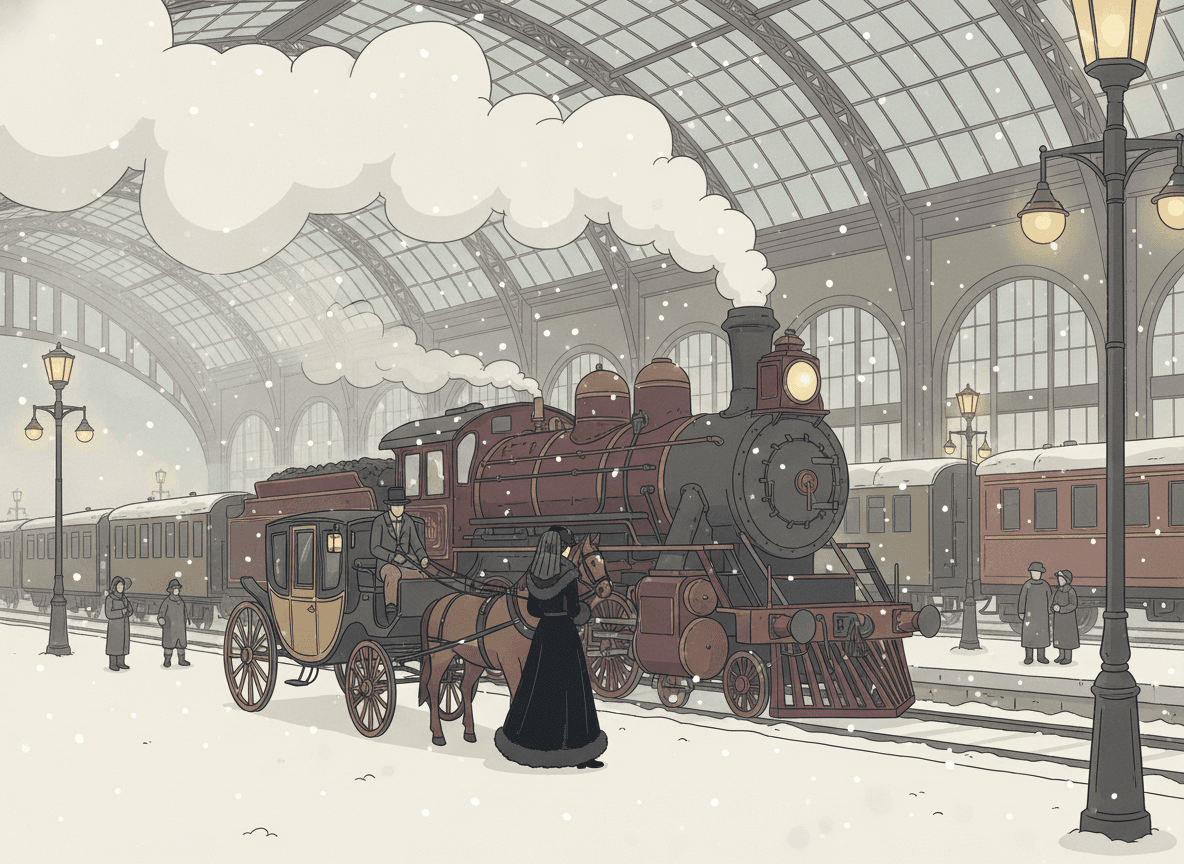
One real event fed the story. In 1872, a woman named Anna Pirogova, the companion of a neighbouring landowner, threw herself under a train near Yasnaya Polyana. Tolstoy went to the railway station to see the body. The image stayed with him.
He wrote slowly, over four years, rewriting constantly and complaining in letters that he was sick of it. The novel appeared in instalments in The Russian Messenger, a Moscow journal, so readers argued over each part as it came. Then came the break. The editor, Mikhail Katkov, refused the final section because Tolstoy had written scornfully about Russians volunteering to fight in the Balkans, a cause Katkov's journal supported. Tolstoy would not cut it. He published the last part himself, as a separate booklet, in 1877.
The finishing of it left him hollow. Within a couple of years he was in a full crisis of faith, which he later described in A Confession, and his life turned toward religion and away from novels.
Readers never let the book go. Fyodor Dostoevsky, his great rival, called it flawless as a work of art. Vladimir Nabokov and William Faulkner both ranked it at the very top of the novel's history. It has been filmed and staged more times than anyone has counted, and its opening sentence about happy and unhappy families is quoted by people who have never opened the book.
Continue in the app
Open the app for the illustrated story of this book, the world it was written in, and the full text, a free public-domain edition, to read on screen or hear read aloud.
- ✓ The illustrated story of the book
- ✓ The world it was written in, on the map and timeline
- ✓ The full text, free, read or read aloud
Illustrations are created with AI assistance. Summaries are written with AI and reviewed by the editor. Book metadata comes from Wikidata and Open Library.