
Books ›
1791 · Beijing
Dream of the Red Chamber
A stone falls in love with the world, and the world does not last.
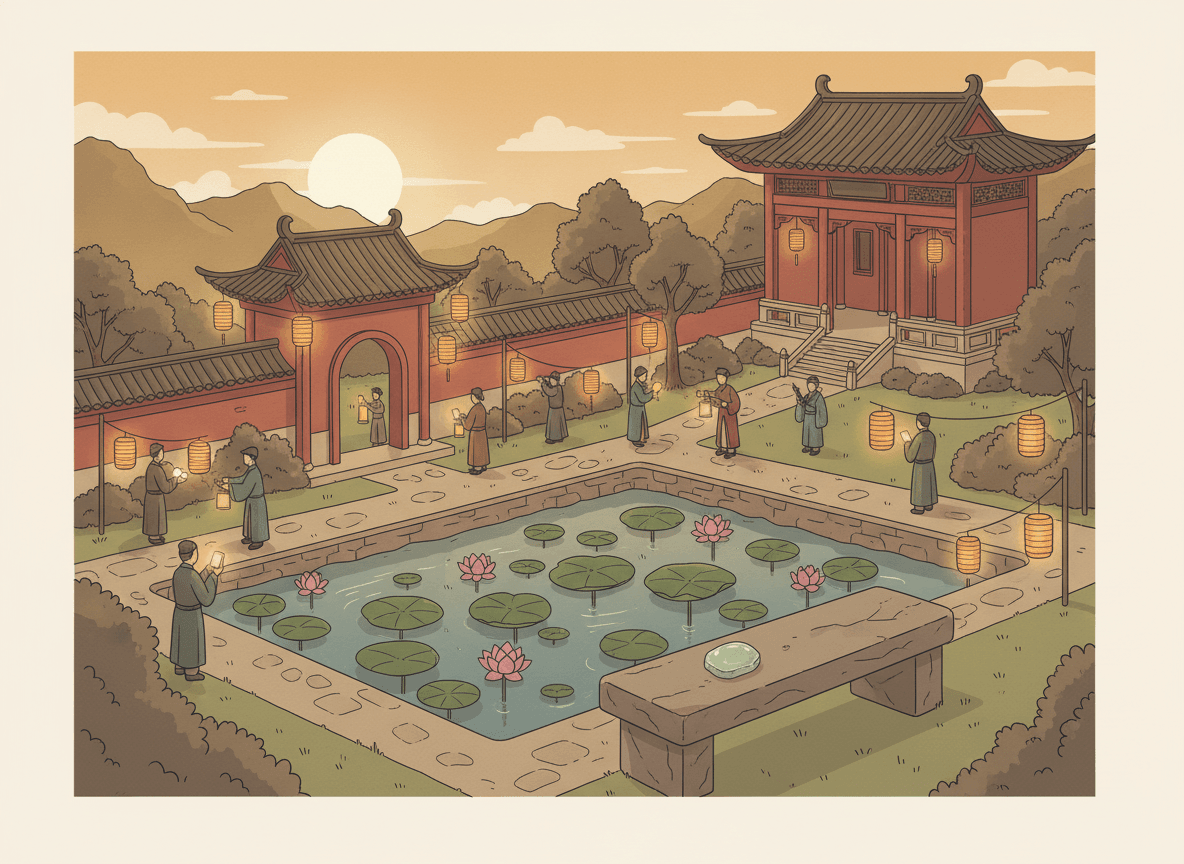
How this book came to be
Dream of the Red Chamber is a vast novel about a wealthy Chinese family's slow ruin, seen through a dreamy young man named Jia Baoyu and the girls he grows up with. It was written by Cao Xueqin, and the story of its making is almost as sad as the book.
Cao was born into privilege. His family had served the Qing emperors for generations, running the imperial textile works in Nanjing, a post that came with money and status. Then the political winds turned. Around 1728 the household was raided and its property seized, and the family moved to Beijing in disgrace. Cao spent his later years poor, on the city's western outskirts, reportedly living on thin porridge and selling paintings. Friends' poems from the time describe him drinking, talking, and writing.
He wrote the novel in that poverty, drawing on the lost world of his childhood. It circulated first not as a printed book but as hand-copied manuscripts passed among friends, under the title Story of the Stone. Those copies carry commentary in red ink by a mysterious annotator known as Zhiyanzhai, or Red Inkstone, who writes as if he knew the real people behind the characters. Cao died around 1763 or 1764 with the book unfinished, roughly eighty chapters in.
In 1791 and 1792, the editors Cheng Weiyuan and Gao E published the first printed editions, adding a further forty chapters to complete the story. Scholars still argue about how much of that ending came from Cao's drafts and how much Gao E supplied. Because the manuscript history is so tangled, the book created its own academic field, Hongxue, or Redology, with generations of researchers comparing surviving copies line by line.
The novel became the most beloved work of Chinese fiction. It has been made into operas, films and long television series, and its characters are household names in Chinese-speaking countries. Readers argue about Lin Daiyu, Baoyu's frail and sharp-tongued cousin, the way English readers argue about Hamlet. David Hawkes and John Minford's English translation, published from 1973, brought that argument to a much wider world.
Continue in the app
Open the app for the illustrated story of this book, the world it was written in, and the full text, a free public-domain edition, to read on screen or hear read aloud.
- ✓ The illustrated story of the book
- ✓ The world it was written in, on the map and timeline
- ✓ The full text, free, read or read aloud
Illustrations are created with AI assistance. Summaries are written with AI and reviewed by the editor. Book metadata comes from Wikidata and Open Library.