
Books ›
c. 1800 to 1200 BC · Uruk
Epic of Gilgamesh
A king and a wild man in the oldest story on Earth, pressed into clay four thousand years ago
How this book came to be
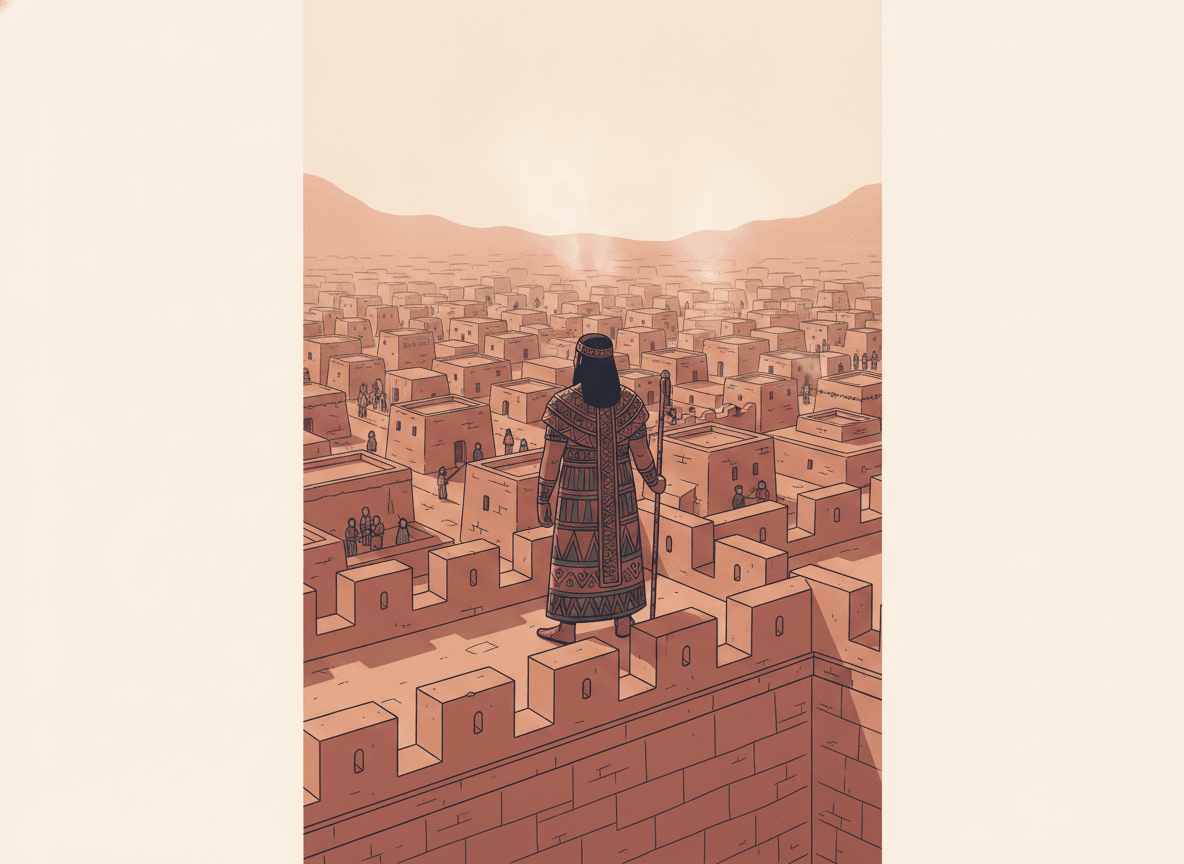
The Epic of Gilgamesh is the oldest long poem we can still read. It follows Gilgamesh, the king of the city of Uruk in southern Mesopotamia (today's Iraq), who befriends a wild man called Enkidu and then, after losing him, goes looking for a way to escape death.
It did not appear all at once. Around 2100 BC, scribes in Sumerian cities were already writing separate short poems about a king they called Bilgames. Some centuries later, around 1800 BC, an Akkadian poet wove those loose stories into one connected epic. That version survives only in pieces, and it opens with a line that means roughly "surpassing all other kings". Later still, probably between 1300 and 1000 BC, an editor named Sin-leqi-unninni produced the fuller version most translations use today. He is one of the earliest authors in history whose name we know, though we know almost nothing else about him.
The poem was written with a reed stylus on wet clay, in the wedge-shaped script we call cuneiform. Clay was the reason it survived. Scribal students copied it for practice across Mesopotamia, and copies turned up as far away as Megiddo and the Hittite capital, translated into other languages. Then the cities fell, the script died out, and for about two thousand years nobody could read a word of it.
It came back by accident. In the 1850s, excavators at Nineveh shipped crates of broken tablets to the British Museum from the library of the Assyrian king Ashurbanipal. In 1872 a young museum assistant, George Smith, was sorting fragments when he found an account of a great flood, a boat and a bird sent out to find land. Because it read so much like the story of Noah, his announcement caused a sensation in Victorian London. A newspaper funded him to go dig for the missing part, and he found more. He died of illness near Aleppo in 1876, aged thirty-six.
The epic is still not complete. New fragments keep surfacing, including a substantial one bought by a museum in Sulaymaniyah in 2011. Every few years, a poem written before the Iliad gets a few more lines.
Continue in the app
Open the app for the illustrated story of this book, the world it was written in, and the full text, a free public-domain edition, to read on screen or hear read aloud.
- ✓ The illustrated story of the book
- ✓ The world it was written in, on the map and timeline
- ✓ The full text, free, read or read aloud
Illustrations are created with AI assistance. Summaries are written with AI and reviewed by the editor. Book metadata comes from Wikidata and Open Library.