
Books ›
1580 · Saint-Michel-de-Montaigne
Essays
A tired nobleman climbs a tower, starts writing about himself, and teaches the world to think out loud.
How this book came to be
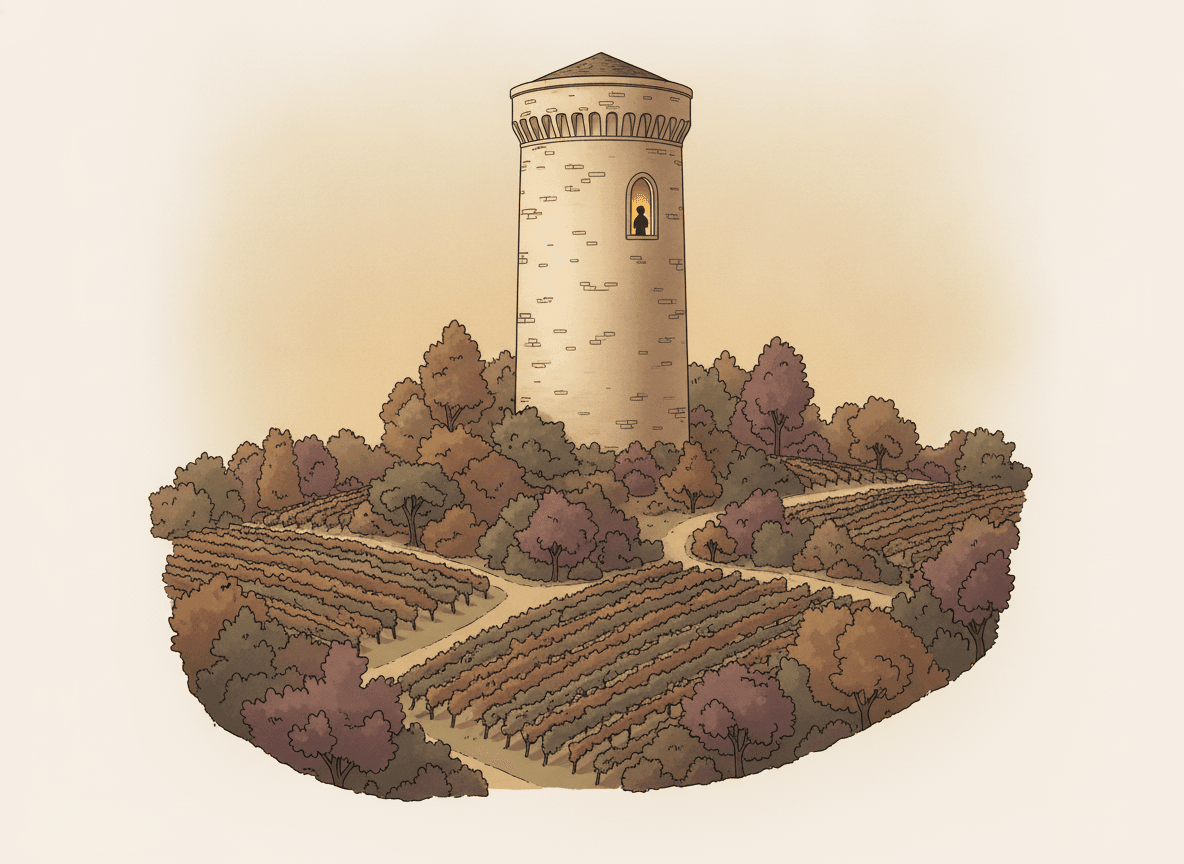
In 1571, on his 38th birthday, Michel de Montaigne quit public life. He had spent years as a magistrate in the Bordeaux parlement, a court of law in southwestern France, and he was tired of it. So he retreated to the round tower of his family estate near Bordeaux, where he kept about a thousand books and had Greek and Latin sayings painted on the ceiling beams. There he began writing short pieces he called essais, meaning attempts or trials. The word had never been used this way before, and it gave us the essay.
He was not writing in peace. France was tearing itself apart in the Wars of Religion, a long series of civil wars between Catholics and Protestants. Montaigne, a Catholic, was trusted by both sides and sometimes worked as a go-between. Plague, massacres and troop movements came close to his door. Grief pushed him too: his closest friend, the writer Étienne de La Boétie, had died in 1563, and some readers think the Essays became the conversation Montaigne could no longer have.
The book is not an argument. It is a man examining himself on every subject that catches his attention, from cannibals to smells to how to die. The first two volumes appeared in Bordeaux in 1580. Montaigne then travelled to Italy, partly hoping the mineral baths would ease his kidney stones. In Rome, church censors questioned parts of the book, though they let him go. He kept adding to it for the rest of his life, and a third volume came in 1588. His copy, thick with handwritten additions in the margins, survives and is known as the Bordeaux Copy.
The Essays travelled fast. John Florio's English translation of 1603 reached Shakespeare, who borrowed from the chapter on cannibals for The Tempest. The Vatican later placed the book on its list of banned works. But it never stopped being read. Pascal argued with it, Nietzsche loved it, and Virginia Woolf wrote about it with delight. Every time someone writes "I" and follows a thought wherever it goes, they are working in the form Montaigne invented.
Continue in the app
Open the app for the illustrated story of this book, the world it was written in, and the full text, a free public-domain edition, to read on screen or hear read aloud.
- ✓ The illustrated story of the book
- ✓ The world it was written in, on the map and timeline
- ✓ The full text, free, read or read aloud
Illustrations are created with AI assistance. Summaries are written with AI and reviewed by the editor. Book metadata comes from Wikidata and Open Library.