
Books ›
1808 · Leipzig
Faust, Part One
A restless scholar makes a deal with a smiling devil, and an innocent woman pays for it.
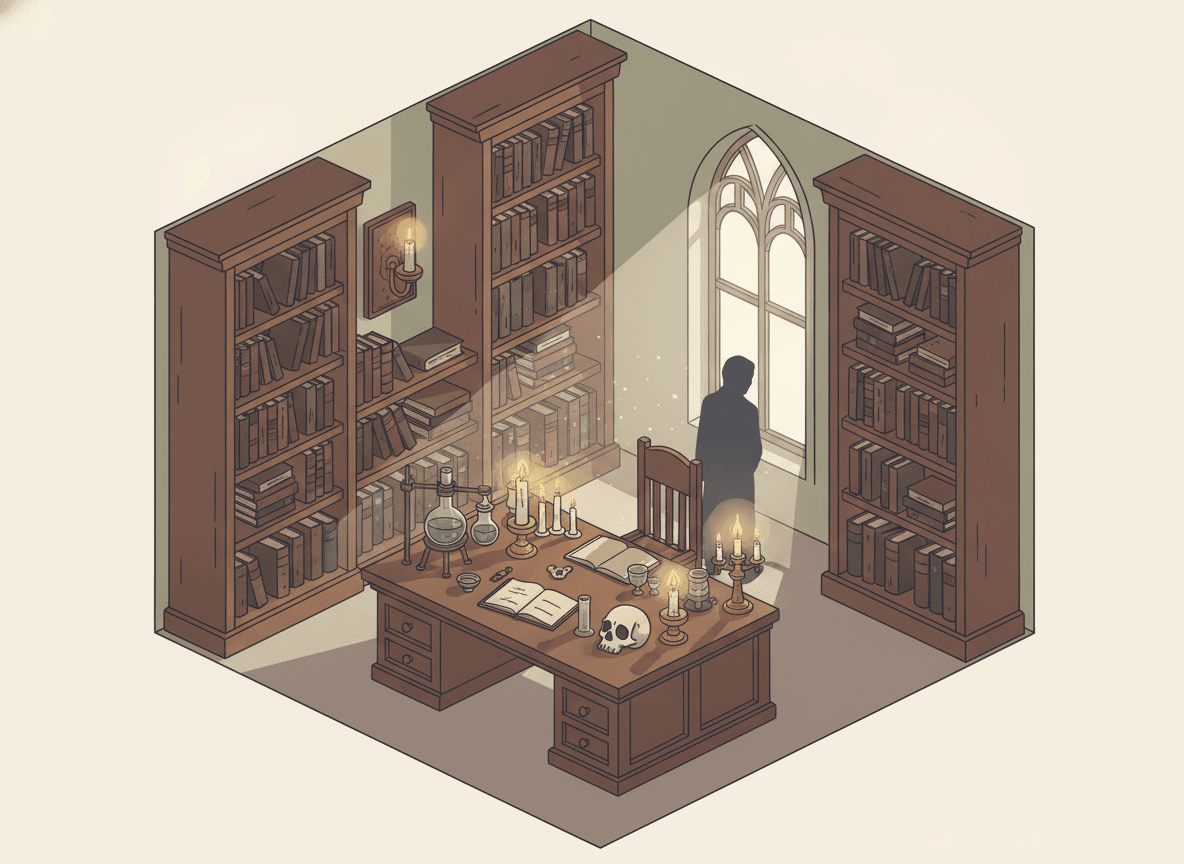
How this book came to be
Faust, Part One is a verse drama about a restless scholar who makes a wager with the devil. Its story of composition is almost as strange as its plot, because Johann Wolfgang von Goethe carried the play with him for roughly sixty years.
He met Faust as a child. Puppet theatres in German towns performed a rough comic version of the legend of Johann Georg Faust, a real magician and confidence man who wandered Germany in the early 1500s. After his death, printers turned him into a cautionary figure. A cheap book from 1587, the Historia von D. Johann Fausten, sold the tale of a scholar who signed away his soul for knowledge and pleasure. That book crossed the Channel and gave Christopher Marlowe, the English playwright, his own Doctor Faustus.
Goethe started writing his version in his twenties, in the 1770s, when he was a young lawyer and a literary celebrity. Then he moved to Weimar to serve at the court of Duke Carl August, and the manuscript sat. He was busy running mines, roads and a theatre. He published a piece of it in 1790 as Faust: Ein Fragment, then let it rest again.
What revived it was friendship. In the 1790s the poet Friedrich Schiller pushed him, letter after letter, to finish the thing. Goethe went back in. The finished Part One appeared in 1808, with the whole Gretchen story that no earlier version of the legend had: a young woman ruined by Faust's love, tried and condemned. That thread turned a folk tale about damnation into something painfully human.
Readers took it up quickly, though the stage was slower, because the play seemed unperformable. A full production of Part One waited until 1829, in Braunschweig. Goethe kept working, and Part Two was published in 1832, months after he died.
The afterlife is enormous. Berlioz, Gounod, Liszt and Schumann all set it to music. Thomas Mann rewrote it for the Nazi era in Doktor Faustus. And the phrase "Faustian bargain" is now used by people who have never opened the book, whenever someone trades their soul for what they want.
Continue in the app
Open the app for the illustrated story of this book and the world it was written in. The book itself is not included: it is still in copyright, so read it on Kindle or import your own EPUB into the app's library.
- ✓ The illustrated story of the book
- ✓ The world it was written in, on the map and timeline
- ✕ The full text is not included (in copyright)
Illustrations are created with AI assistance. Summaries are written with AI and reviewed by the editor. Book metadata comes from Wikidata and Open Library.