
Books ›
1532 to 1564 · Chinon
Gargantua and Pantagruel
Two giants, a clever coward, and a sea voyage to ask a bottle how to live.
How this book came to be
In 1532, François Rabelais was a doctor at the Hôtel-Dieu hospital in Lyon. He was also a former monk who had left monastic life, and a scholar who read Greek at a time when reading Greek could get you accused of heresy. Lyon was then the busiest printing town in France, full of merchants, fairs and cheap books. Rabelais noticed that one of those cheap books, an anonymous comic tale about a giant, was selling faster than anything else on the stalls. So he wrote his own giant book, published Pantagruel under the anagram-pen-name Alcofribas Nasier, and followed it in about 1534 with Gargantua, the story of Pantagruel's father.
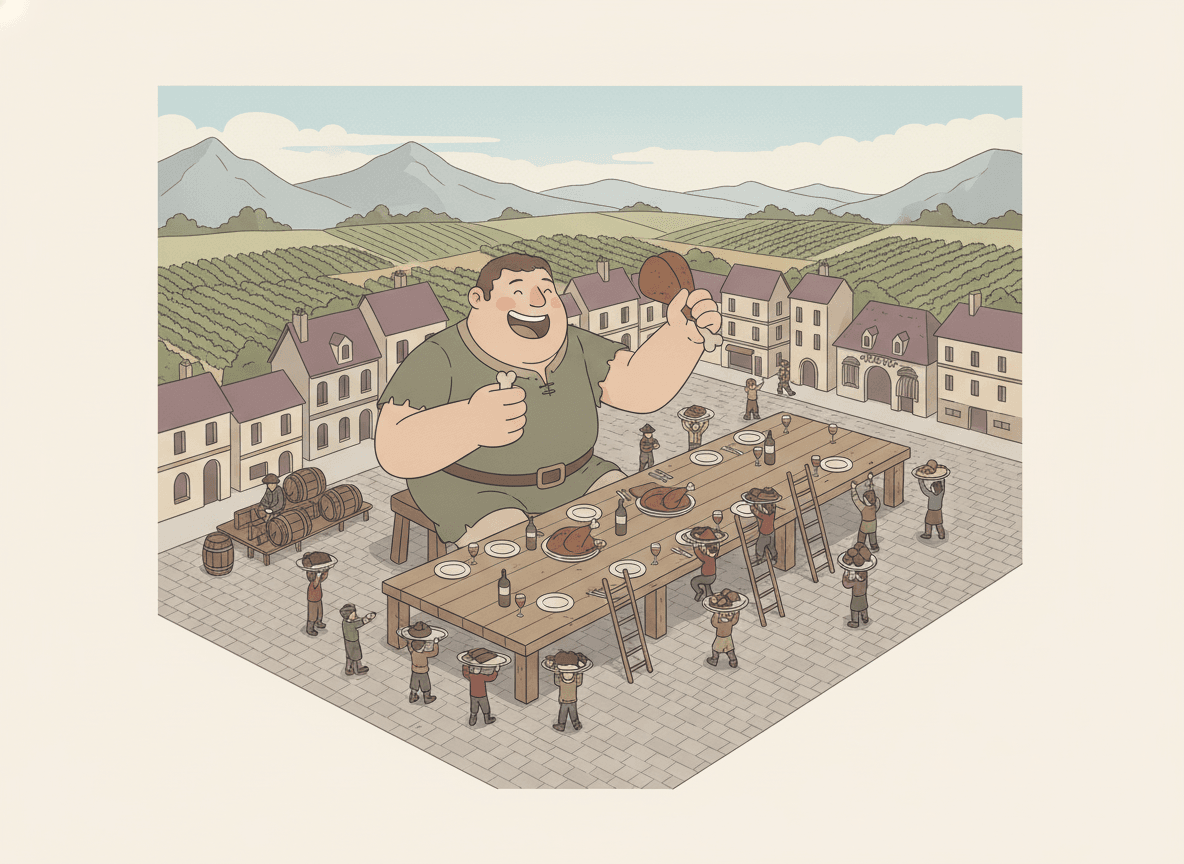
The books are comic prose narratives about a family of good-natured giants, stuffed with jokes, feasts, invented words, mock-scholarly lists and sudden serious arguments about education, war and religion. That mixture was the point. Rabelais used the loud laughter of the fairground book to smuggle in the ideas of the new humanist learning, which valued ancient languages, plain reading of texts and schooling built on curiosity rather than beatings.
The reaction split. Readers bought the books eagerly. The theology faculty of the Sorbonne in Paris condemned them as obscene, because mocking monks and pilgrims looked dangerous during years when France was burning Protestants. Rabelais had protection, though. He served the powerful Du Bellay family, travelled to Rome with them, and even obtained a royal privilege to print his work. He kept publishing anyway, adding the Third Book and Fourth Book, which were also censured. Rabelais died in 1553. A Fifth Book appeared about a decade later, around 1564, and scholars still argue about how much of it is really his.
His afterlife is enormous. His name became an adjective: Rabelaisian, meaning earthy, exuberant, unafraid of the body. Writers from Laurence Sterne to James Joyce learned from his wordplay, and the Russian critic Mikhail Bakhtin built a whole theory of "carnival" literature around him, arguing that comic excess is how ordinary people answer power. French still keeps his coinages, and readers still open him for the shock of finding a Renaissance book that behaves like a party.
Continue in the app
Open the app for the illustrated story of this book, the world it was written in, and the full text, a free public-domain edition, to read on screen or hear read aloud.
- ✓ The illustrated story of the book
- ✓ The world it was written in, on the map and timeline
- ✓ The full text, free, read or read aloud
Illustrations are created with AI assistance. Summaries are written with AI and reviewed by the editor. Book metadata comes from Wikidata and Open Library.