
Books ›
1726 · Indian Ocean
Gulliver's Travels
A ship's surgeon sails out full of curiosity and comes home unable to bear the smell of his own family. Follow Lemuel Gulliver to find out why.
How this book came to be
In 1726, a book appeared in London with no author's name on it. It claimed to be the honest travel journal of one Lemuel Gulliver, a ship's surgeon who had washed up in four strange countries: a land of tiny people, a land of giants, a flying island of distracted scientists, and a country where horses reason and humans do not. It was a hoax, and everyone knew it was a hoax, and it sold out in a week.
The real author was Jonathan Swift, an Anglo-Irish clergyman who by then was Dean of St Patrick's Cathedral in Dublin. Swift had wanted power in London. He had written brilliant political pamphlets for the Tory government, and when that government collapsed in 1714 with the death of Queen Anne, his side lost everything. Dublin felt to him like exile. He worked on the Travels through the early 1720s in that soured mood, while also writing furious pamphlets defending Ireland against English economic control.
So the book is a satire, and its target is broad: political parties, courts, war, empire, scientific projects that help nobody, and the human habit of assuming we are the reasonable species. Swift told his friend Alexander Pope, the poet, that his aim was to vex the world rather than divert it.
He took no chances with publication. The manuscript was reportedly dropped at the publisher's house by an unknown messenger, and Swift kept his name off it for years. The publisher softened some of the sharpest political passages anyway, which infuriated Swift, and corrected texts followed later.
Readers devoured it. It was read at court and in coffee houses, pirated, abridged, and translated into French within a couple of years. Then something odd happened. The book slipped loose from its politics and became a children's story. Cut down to the voyages to Lilliput and Brobdingnag, stripped of the bitterness, it turned into a nursery favourite for two centuries.
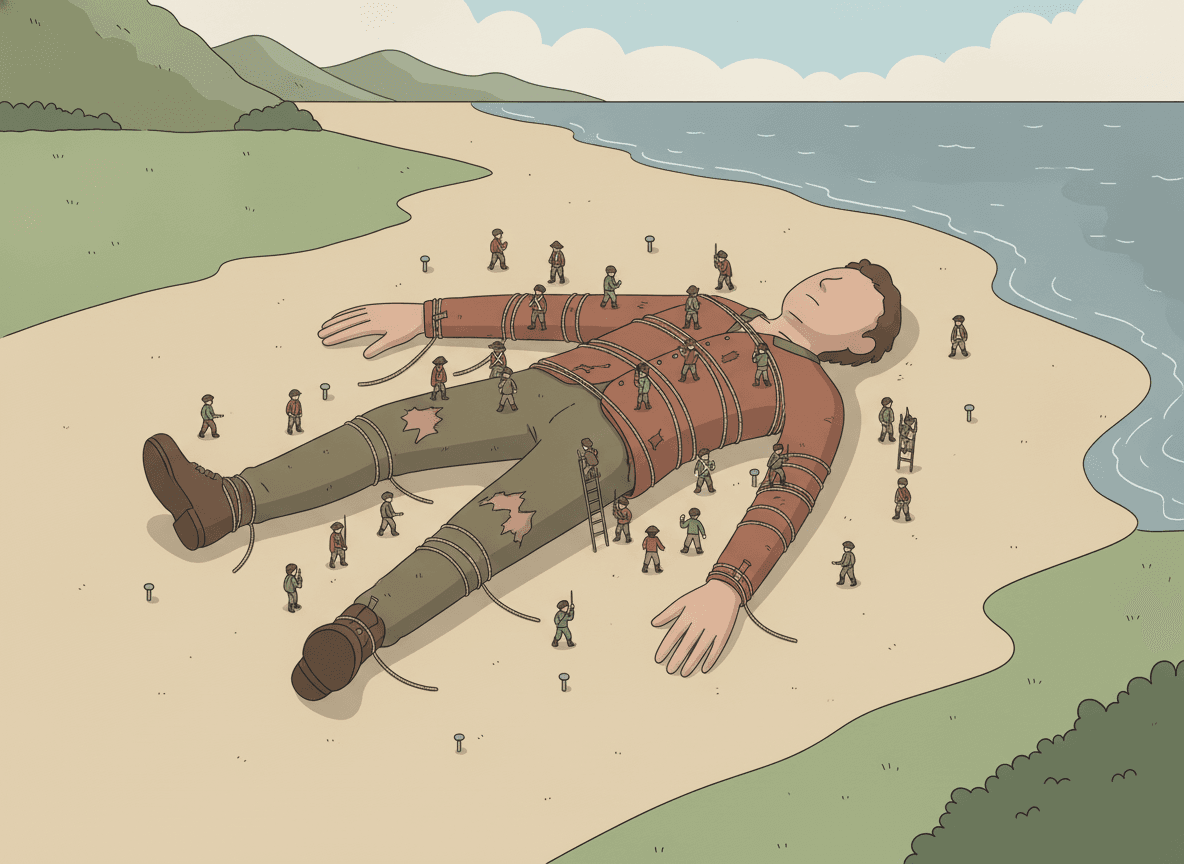
Both lives continue. Children still meet Gulliver pinned to the ground by threads. Adults still argue about the last voyage, which is one of literature's coldest looks at what people are. And English gained a word from it: Lilliputian.
Continue in the app
Open the app for the illustrated story of this book, the world it was written in, and the full text, a free public-domain edition, to read on screen or hear read aloud.
- ✓ The illustrated story of the book
- ✓ The world it was written in, on the map and timeline
- ✓ The full text, free, read or read aloud
Illustrations are created with AI assistance. Summaries are written with AI and reviewed by the editor. Book metadata comes from Wikidata and Open Library.