
Books ›
8th century BC · Troy
Iliad
Fifty days in the tenth year of a war, and the rage of one man that emptied a battlefield.
How this book came to be
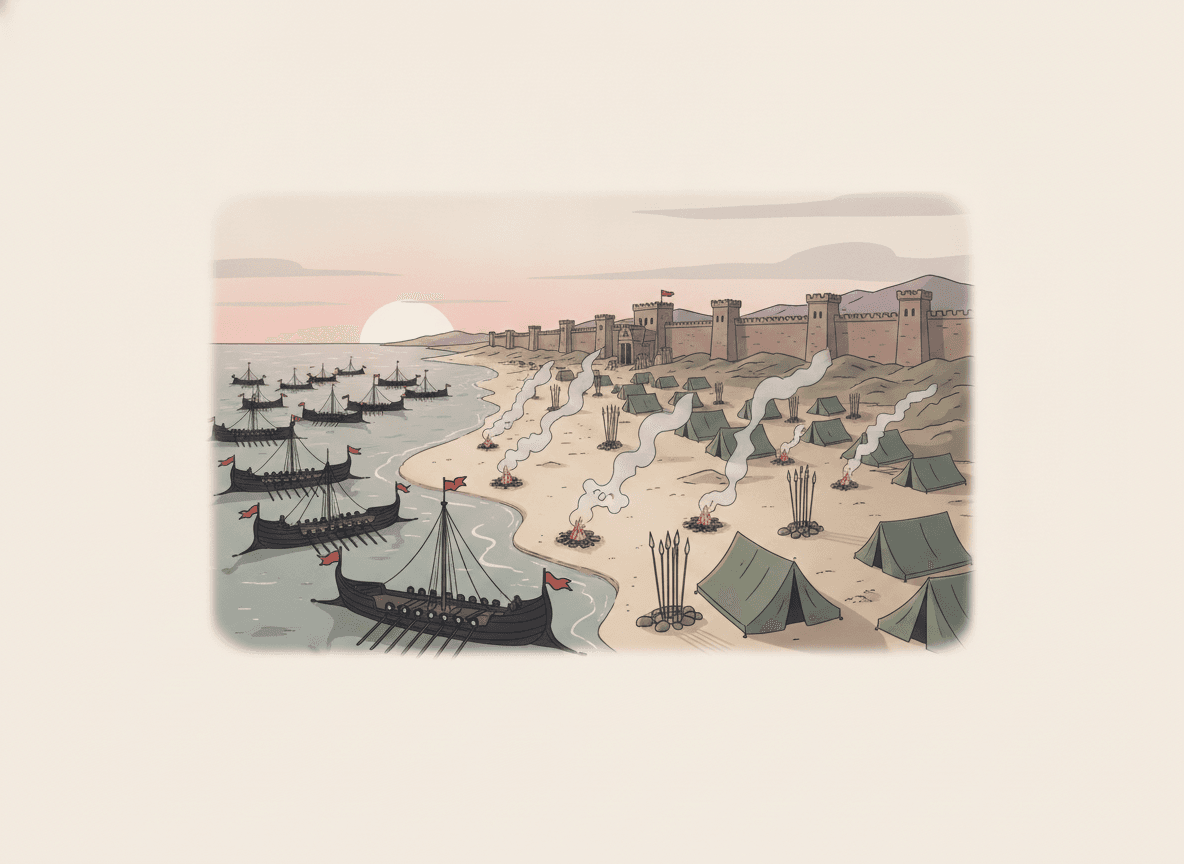
The Iliad is a Greek epic poem of about 15,700 lines. It covers a few weeks in the tenth year of a long siege of the city of Troy, and it turns on the rage of Achilles, the best fighter in the Greek army, after his commander takes a captive woman from him.
Nobody can point to a desk where it was written. The poem grew out of a tradition of singing bards who performed for audiences without a written text. These singers used a stock of ready-made phrases and repeated lines, which let them build long stretches of verse in performance. The rhythm is dactylic hexameter, a steady six-beat line that carried the story and helped the singer hold it in memory. Scholars date the version we have to roughly 750 BC, in the Greek-speaking world of the eastern Aegean, right around the time the Greeks adopted an alphabet from Phoenician traders. That timing matters, because writing is probably what fixed a fluid oral poem into a text.
Who Homer was is genuinely unknown. Ancient Greeks told stories of a blind poet from Chios or Smyrna, but there is no reliable evidence, and scholars have argued for centuries over whether one person, several, or a whole tradition stands behind the name. This is called the Homeric Question, and it remains open.
The poem became the shared property of Greece. Boys learned it by heart in school. Reciters called rhapsodes performed it at festivals, and Athenian tradition credits the ruler Peisistratus with ordering an official version for the great Panathenaic festival. Scholars at the library of Alexandria, among them Aristarchus, edited the text line by line in the second and third centuries BC, and their marginal notes survive in a beautiful tenth-century manuscript in Venice.
Its afterlife is enormous. The Roman poet Virgil wrote the Aeneid as an answer to it. George Chapman's English version in 1611 and Alexander Pope's in the 1710s made it an English classic in turn. In the 1870s Heinrich Schliemann dug at Hisarlik in Turkey, convinced he had found Troy, and most archaeologists now agree the site is the right one, even if the war in the poem is not history.
Continue in the app
Open the app for the illustrated story of this book, the world it was written in, and the full text, a free public-domain edition, to read on screen or hear read aloud.
- ✓ The illustrated story of the book
- ✓ The world it was written in, on the map and timeline
- ✓ The full text, free, read or read aloud
Illustrations are created with AI assistance. Summaries are written with AI and reviewed by the editor. Book metadata comes from Wikidata and Open Library.