
Books ›
1592 · Chang'an
Journey to the West
A monk, a pig, a river spirit and the trickster Monkey King who fought Heaven and won a second chance
How this book came to be
Journey to the West is a hundred-chapter Chinese novel, printed around 1592, that turns a real pilgrimage into a comic adventure full of demons, gods and one very unruly monkey. The pilgrimage was real. In 629 CE a Buddhist monk named Xuanzang slipped out of China against imperial orders and walked to India to fetch Buddhist scriptures, returning sixteen years later a national celebrity. He wrote an account of the lands he crossed, and storytellers spent the next nine centuries doing what storytellers do: adding monsters.
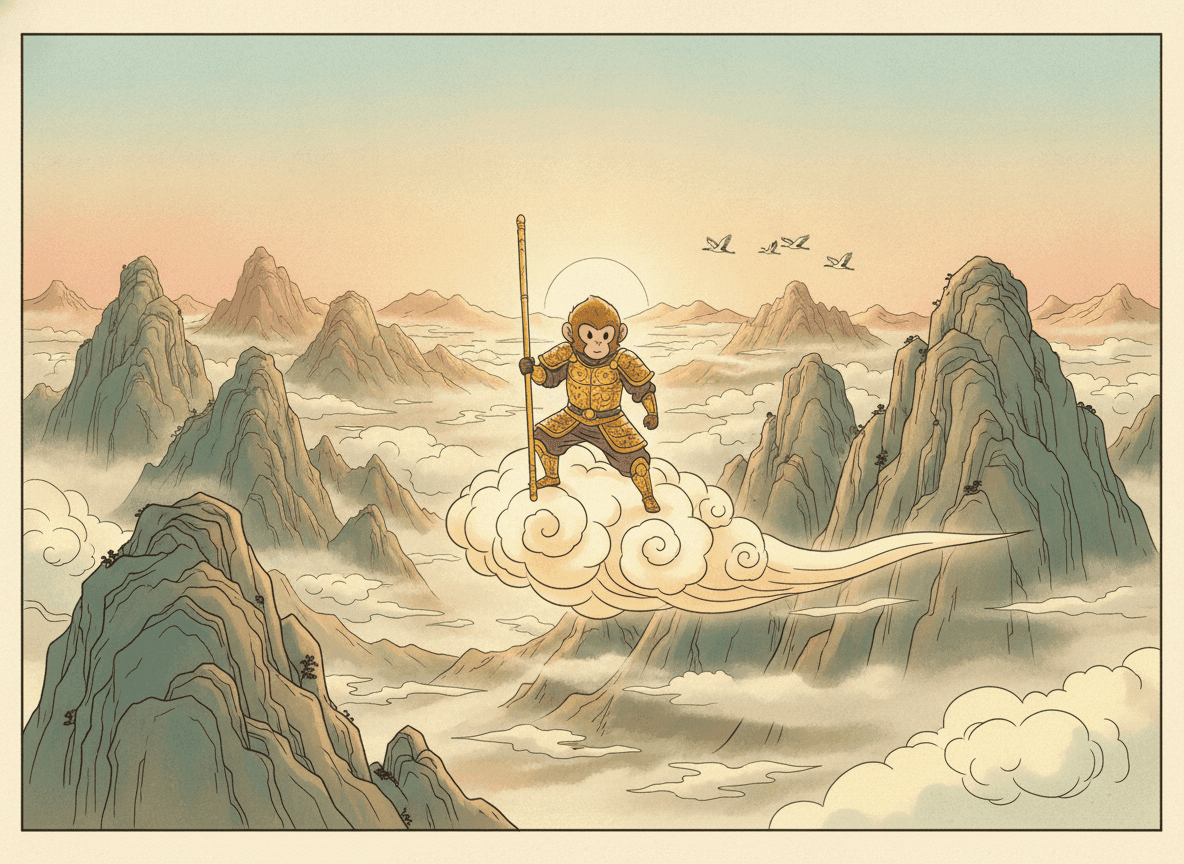
By the Ming dynasty the pilgrim monk already had companions in popular tales, above all Sun Wukong, the Monkey King, a stone-born trickster with a magic staff. Puppet shows, temple performances and street storytellers had polished these episodes for generations. So the novel was less invented than gathered, then reshaped by a writer with a gift for satire. The heavenly bureaucracy in the book, with its forms, ranks and petty officials, reads a lot like the Ming civil service.
Here is the honest part: nobody knows for certain who wrote it. The first known edition, published in Nanjing in 1592, carries no author's name. The attribution to Wu Cheng'en, a minor scholar from Huai'an who failed to climb the examination ladder, comes from a local gazetteer listing a work of that title, and it was argued into acceptance in the 1920s by the scholars Hu Shi and Lu Xun. Many specialists still treat it as probable rather than proven.
The book sold, was reprinted, was moralized over by commentators who read it as Buddhist or Daoist allegory, and was read anyway by people who mostly wanted more Monkey. It reached English readers in 1942 through Arthur Waley's lively abridgement Monkey, and in full through Anthony C. Yu's translation, completed in 1983.
Its afterlife is enormous. Chinese opera built roles around Monkey. The 1961 animated film Havoc in Heaven and a beloved 1986 television series fixed his image for millions. In Japan, Monkey shaped Son Goku of Dragon Ball, which means a Ming novel about a stone ape is quietly ancestral to a large slice of modern pop culture.
Continue in the app
Open the app for the illustrated story of this book, the world it was written in, and the full text, a free public-domain edition, to read on screen or hear read aloud.
- ✓ The illustrated story of the book
- ✓ The world it was written in, on the map and timeline
- ✓ The full text, free, read or read aloud
Illustrations are created with AI assistance. Summaries are written with AI and reviewed by the editor. Book metadata comes from Wikidata and Open Library.