
Books ›
1855 to 1892 · Brooklyn
Leaves of Grass
One man sits down in the grass and tries to sing the whole of America into a single poem.
How this book came to be
In 1855, a Brooklyn newspaperman and carpenter's son named Walt Whitman did something no serious poet was supposed to do. He printed his own book.
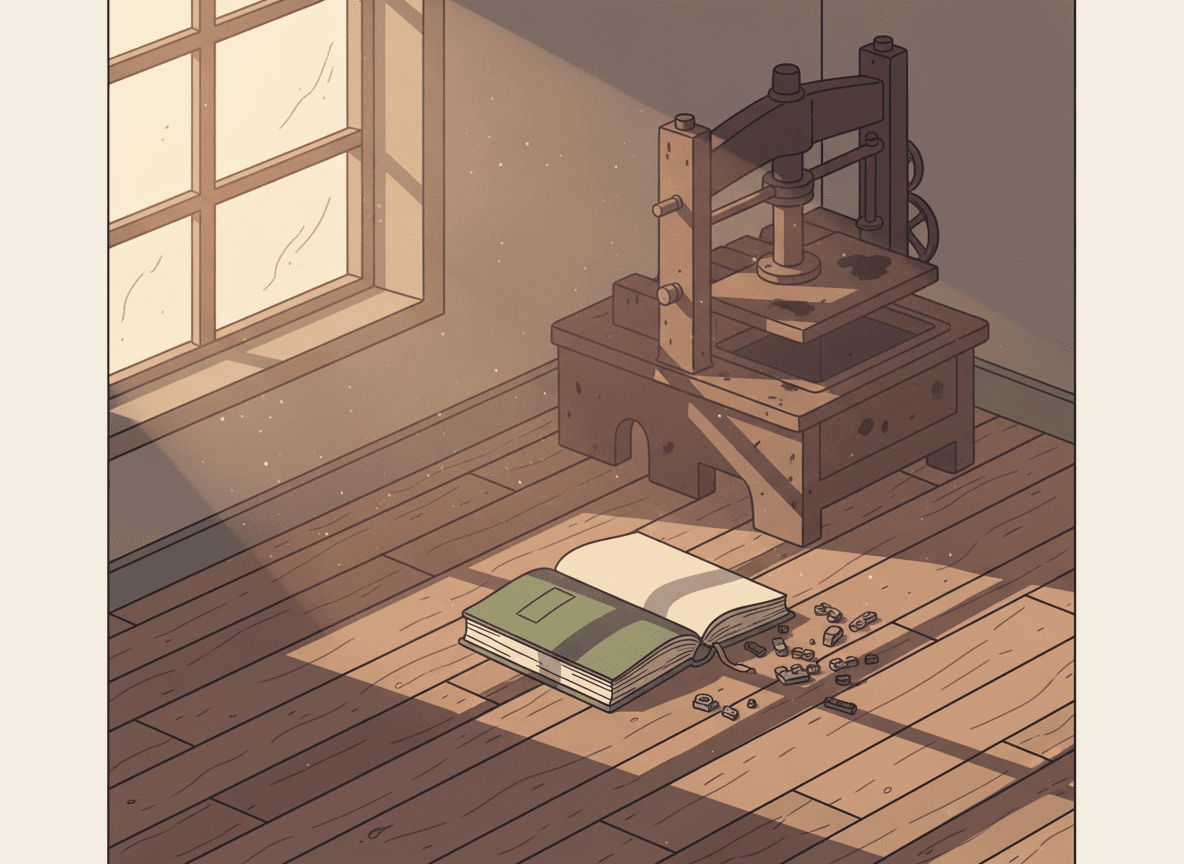
Whitman was in his mid thirties, living in Brooklyn, New York, and drifting between jobs as an editor, a printer and a builder of houses. He had trained in print shops as a boy, so he knew type and paper the way a carpenter knows wood. That knowledge shaped the book. He took his manuscript to the Rome Brothers shop in Brooklyn and, by his own account, set some of the type himself.
The result was strange on purpose. Leaves of Grass is a collection of poems, twelve of them in that first edition, all untitled, written in long unrhymed lines that sound closer to speech or scripture than to the neat stanzas readers expected. The subject was America itself, and the poet's own body and self inside it. The title page carried no author's name. Instead there was an engraved portrait of a man in a workman's shirt, hat tilted, collar open.
About eight hundred copies were printed, and most readers ignored them. A few were disgusted by the frank treatment of the body and sex. But Ralph Waldo Emerson, then the most respected thinker in the country, wrote Whitman a private letter greeting him at the beginning of a great career. Whitman, never shy, had part of that line stamped in gold on the spine of his next edition. Emerson had not given permission.
Whitman never really finished the book. He kept adding, cutting and rearranging for nearly forty years, through the Civil War, in which he worked as a volunteer nurse in army hospitals, until the final version he prepared as he was dying in 1891 and 1892. In 1882 a Boston prosecutor called it obscene and Whitman's publisher dropped it, which only made people want to read it.
Because Whitman threw out rhyme and meter and trusted the rhythm of ordinary American speech, poets after him had permission to do the same. Free verse in English largely starts here.
Continue in the app
Open the app for the illustrated story of this book, the world it was written in, and the full text, a free public-domain edition, to read on screen or hear read aloud.
- ✓ The illustrated story of the book
- ✓ The world it was written in, on the map and timeline
- ✓ The full text, free, read or read aloud
Illustrations are created with AI assistance. Summaries are written with AI and reviewed by the editor. Book metadata comes from Wikidata and Open Library.