
Books ›
1857 · former 11th arrondissement of Paris
Les Fleurs du mal
A poet reaches for the light, sinks into the gray of Paris, and finally sets sail to hunt for something new.
How this book came to be
Charles Baudelaire was in his mid-thirties and deep in debt when Les Fleurs du mal reached print in June 1857. He had spent more than a decade in Paris writing poems, publishing scattered pieces in small reviews, and living off an allowance controlled by a court-appointed trustee, because his family had decided he could not manage his inheritance. The book is a collection of poems, most of them formally strict sonnets and rhymed stanzas, about desire, boredom, death and the modern city.
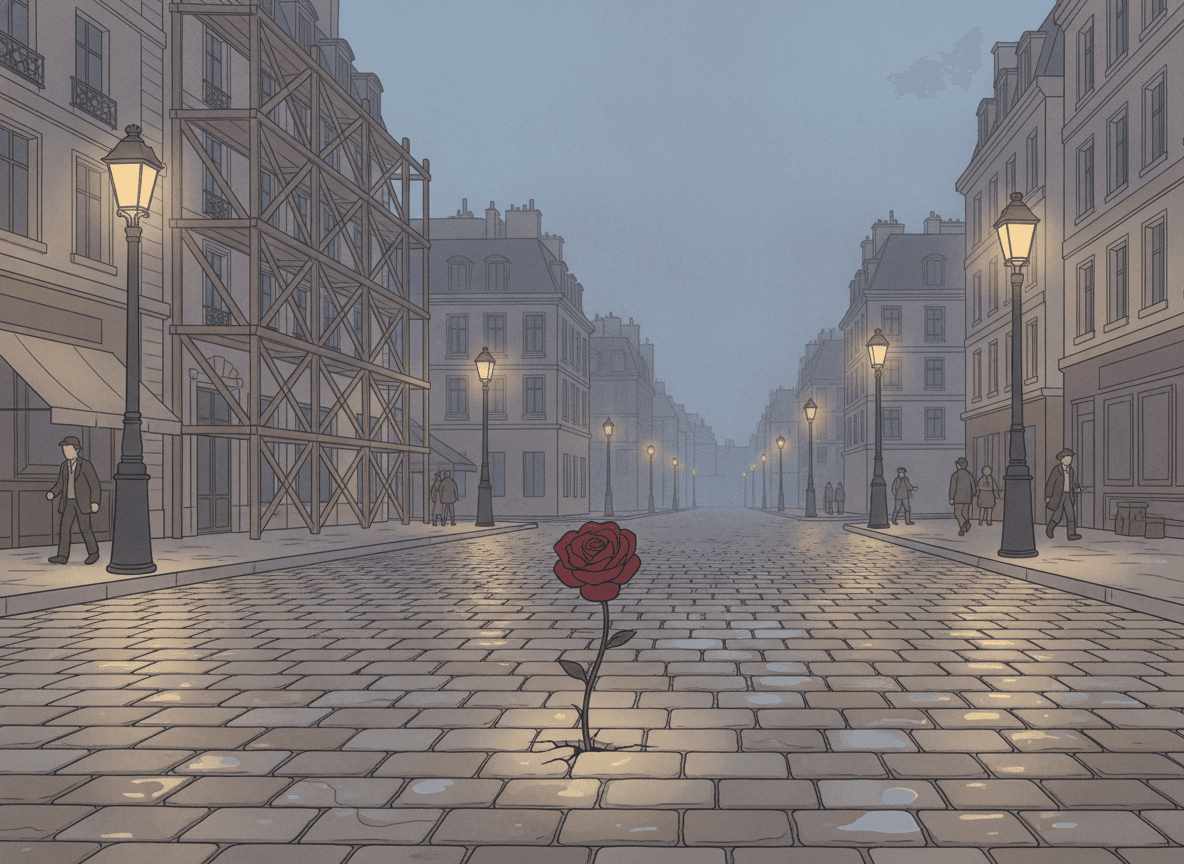
Paris itself was the material. Baron Haussmann was tearing the old streets apart to build the boulevards, and Baudelaire watched the city he knew disappear. He wrote about beggars, gamblers, rag-pickers and prostitutes in the same polished verse forms other poets kept for love and landscapes. That collision was the point. He also spent years translating Edgar Allan Poe, the American writer whose work he championed in France, and Poe's taste for the morbid and the strange left marks on his own.
The reaction was fast and hostile. Within weeks a review in Le Figaro attacked the book, and the government's public morals office prosecuted Baudelaire and his publisher. A court fined them and ordered six poems cut for offending public decency. The banned pieces stayed officially forbidden in France until 1949, when the ruling was finally overturned. Baudelaire, humiliated but not silenced, published an expanded second edition in 1861 with thirty-five new poems.
He never saw the book succeed. He suffered a stroke in 1866, lost the ability to speak, and died in Paris in 1867 at forty-six. Recognition came after. Poets who followed, among them Verlaine, Rimbaud and Mallarmé, treated him as the starting point of modern poetry, and later T. S. Eliot and Walter Benjamin built readings of the modern city on his work. His idea of the flâneur, the watcher who drifts through crowds collecting impressions, became a standard way of thinking about urban life. The scandal that nearly buried the book is now the reason people remember when poetry stopped being polite.
Continue in the app
Open the app for the illustrated story of this book, the world it was written in, and the full text, a free public-domain edition, to read on screen or hear read aloud.
- ✓ The illustrated story of the book
- ✓ The world it was written in, on the map and timeline
- ✓ The full text, free, read or read aloud
Illustrations are created with AI assistance. Summaries are written with AI and reviewed by the editor. Book metadata comes from Wikidata and Open Library.