
Books ›
c. 1606 · Inverness
Macbeth
Shakespeare's shortest tragedy: a prophecy, a murder, and a crown that never lets you sleep
How this book came to be
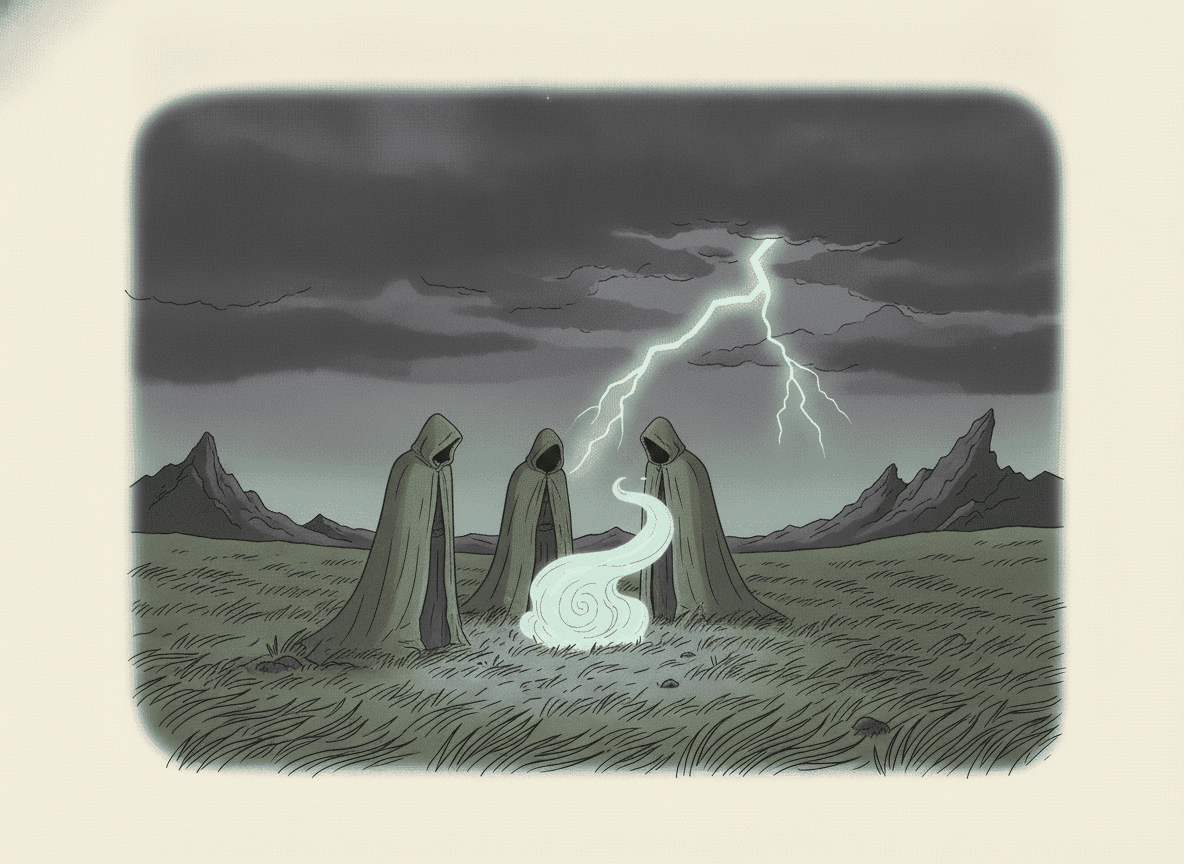
Macbeth is a tragedy about a Scottish soldier who murders his king to take the crown, and then cannot stop killing. It is the shortest of Shakespeare's tragedies, and the fastest.
He wrote it around 1606, most likely in London, where he worked as an actor, part-owner and house playwright for the theatre company he belonged to. Three years earlier that company had gained a powerful new patron. Queen Elizabeth I died in 1603 without children, so the throne passed to her cousin's son, James VI of Scotland, who became James I of England. The players were renamed the King's Men and performed at court. Shakespeare was writing, in effect, for his boss.
That matters, because the play is stuffed with James's own interests. James was Scottish, and the play is Scottish. James had published a book about witchcraft called Daemonologie in 1597, and the play opens with witches. James's line was traced back to Banquo, a character in the play whose descendants are shown stretching into the future. And in November 1605 a group of Catholic plotters was caught trying to blow up Parliament and kill the king. The trials that followed turned on equivocation, the idea that you could mislead under oath without technically lying. The porter in Macbeth jokes about an equivocator, which is one reason scholars date the play to 1606.
We have no manuscript. The text survives only because two of Shakespeare's colleagues collected his plays after his death and printed them in 1623 in the book now called the First Folio. Without that volume, Macbeth would almost certainly be lost. The version we read is short and slightly odd in places, and many scholars think it was cut, and that some witch material was added later by another playwright, Thomas Middleton.
Its afterlife is enormous. "Tomorrow, and tomorrow, and tomorrow" and "out, damned spot" entered ordinary English. Verdi made it an opera in 1847. Kurosawa moved it to feudal Japan in Throne of Blood. Theatre people still refuse to say its name inside a theatre, calling it "the Scottish play" instead, a superstition of uncertain origin but stubborn life.
Continue in the app
Open the app for the illustrated story of this book, the world it was written in, and the full text, a free public-domain edition, to read on screen or hear read aloud.
- ✓ The illustrated story of the book
- ✓ The world it was written in, on the map and timeline
- ✓ The full text, free, read or read aloud
Illustrations are created with AI assistance. Summaries are written with AI and reviewed by the editor. Book metadata comes from Wikidata and Open Library.