
Books ›
1857 · Rouen
Madame Bovary
A farmer's daughter who wanted her life to feel like the novels she read.
How this book came to be
In 1851, Gustave Flaubert came home to Croisset, a quiet house on the Seine just outside Rouen in Normandy, and started a book he did not especially want to write. Before his long journey through the East, he had read his friends a feverish story called The Temptation of Saint Anthony. They told him to burn it. Louis Bouilhet, a poet and his closest reader, suggested the opposite cure: take a plain, ordinary subject and treat it coldly. The subject was reportedly drawn from a local scandal involving the family of a country health officer, though how closely Flaubert followed it is still argued.
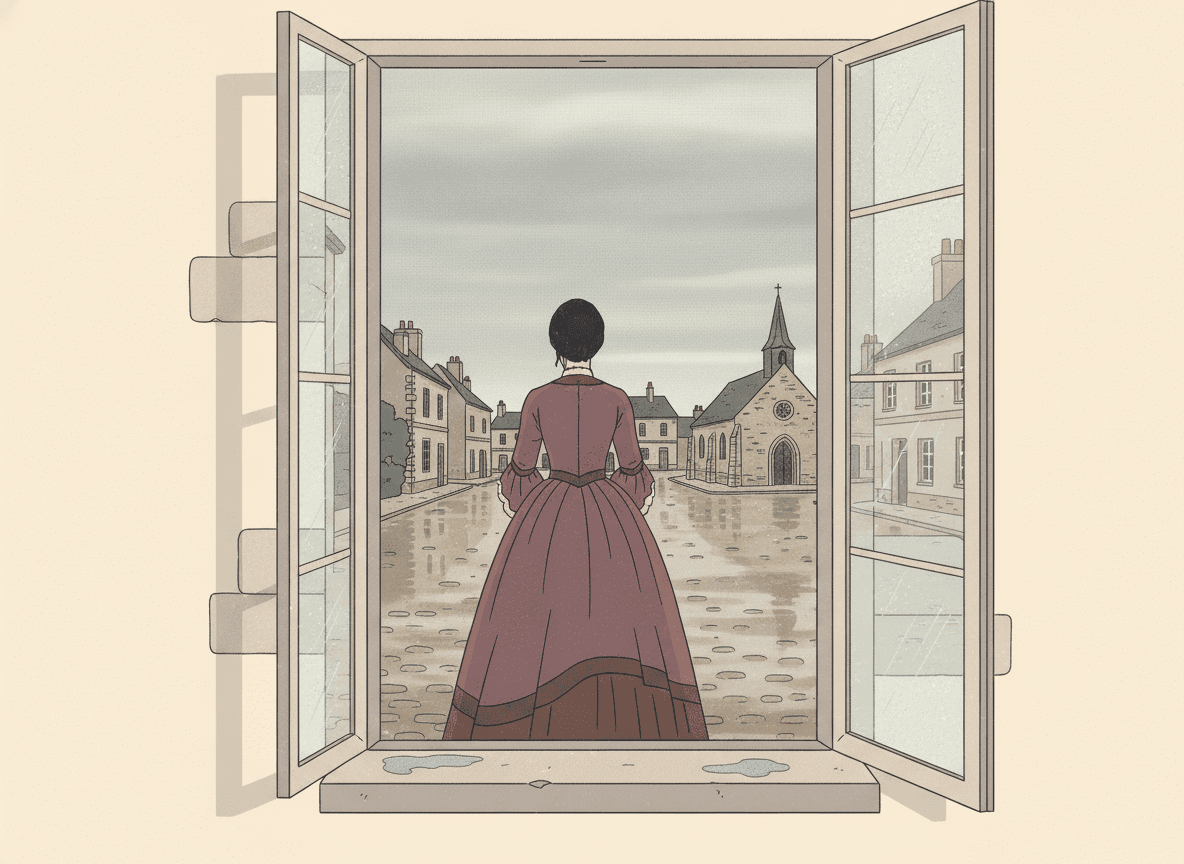
The result is a novel about Emma Bovary, a farmer's daughter married to a dull provincial doctor, who tries to live the life she has read about in romantic books. That is all you need to know going in.
Writing it took nearly five years. Flaubert worked at night, sometimes producing a single page in a week, because he was hunting for what he called le mot juste, the exact word. He shouted his sentences aloud in a room he nicknamed the gueuloir, testing them by ear until the rhythm held. His letters from those years are a long record of suffering over commas.
The novel appeared in installments in the Revue de Paris in late 1856. The government of Napoleon III promptly prosecuted Flaubert, his editor and his printer for offending public morals and religion. The charge was that the book made adultery seem attractive, since the narrator never steps in to condemn Emma. That refusal to judge was exactly the point. Flaubert was acquitted in February 1857, and the trial worked as free advertising. When Michel Lévy published the book that April, it sold fast.
Afterward, novelists everywhere took the lesson: a story could be told without a moralizing voice, in prose as controlled as poetry. Flaubert's method shaped realism and naturalism, and later writers from Henry James to Vladimir Nabokov treated the book as a technical model. The famous line "Madame Bovary, c'est moi" is attached to him everywhere, but there is no solid evidence he ever said it.
Continue in the app
Open the app for the illustrated story of this book, the world it was written in, and the full text, a free public-domain edition, to read on screen or hear read aloud.
- ✓ The illustrated story of the book
- ✓ The world it was written in, on the map and timeline
- ✓ The full text, free, read or read aloud
Illustrations are created with AI assistance. Summaries are written with AI and reviewed by the editor. Book metadata comes from Wikidata and Open Library.