
Books ›
c. 400 BC to 400 AD · Kurukshetra
Mahabharata
Two branches of one family, a rigged game of dice, and a war that ends a world.
How this book came to be
The Mahabharata is the longest epic poem in the world, and it did not arrive in one piece. Tradition credits it to Veda Vyasa, a sage who is also a character inside the story, but scholars think the text grew over roughly eight centuries, from around 400 BC to 400 AD. Poets and reciters added to it, layer by layer, until it swelled to about 100,000 verses. That is around ten times the Iliad and the Odyssey combined.
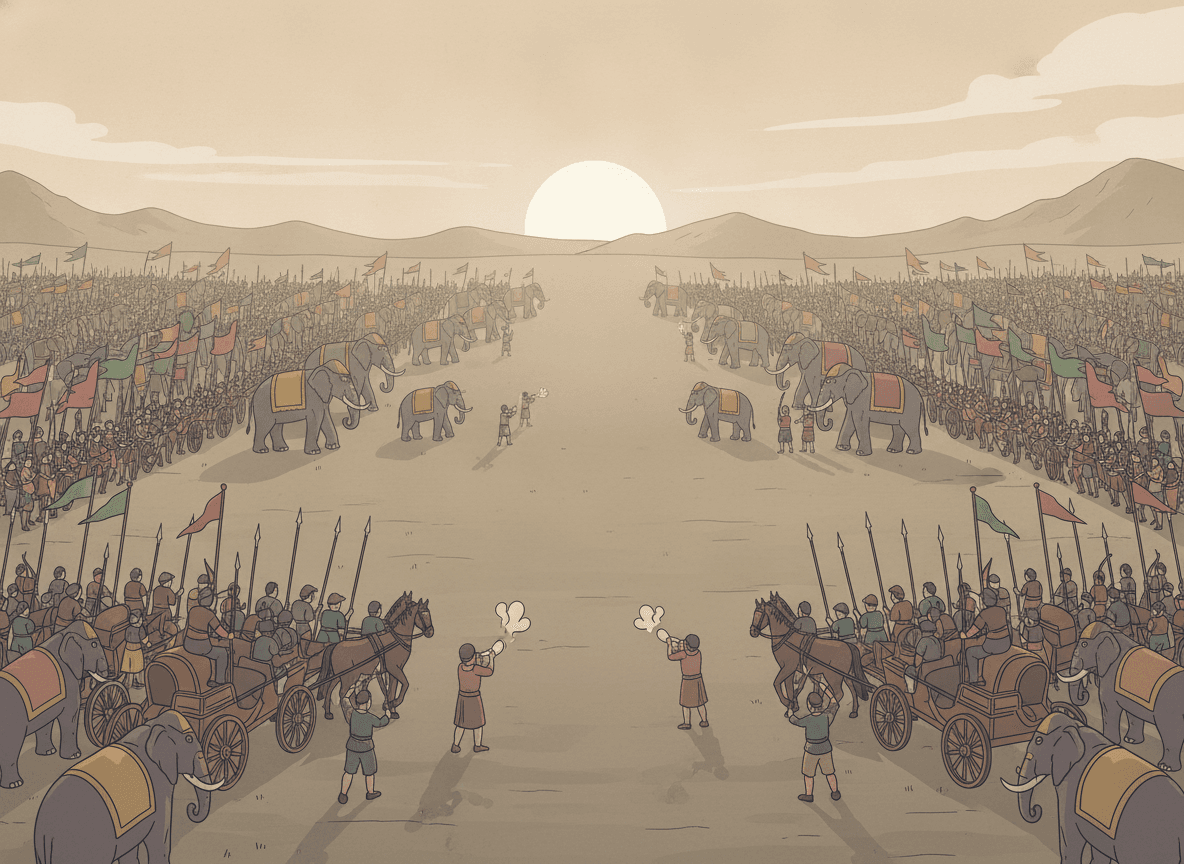
At its center is a war between two branches of one royal family, the Pandavas and the Kauravas, cousins fighting over a throne. The battlefield of Kurukshetra, north of modern Delhi, gives the war its name. Around that quarrel the epic packs genealogies, myths, riddles and long arguments about duty.
It began as spoken poetry, not writing. Bards recited it aloud at courts and at religious gatherings, which is why the text carries repeated phrases and formulas that help a performer remember. Because it was living speech, it kept absorbing new material. One inserted section became a scripture on its own: the Bhagavad Gita, a conversation between the warrior Arjuna and his charioteer Krishna, who is also a god. Arjuna freezes before the fighting starts because he cannot bear to kill his own relatives. The Gita is Krishna's answer, and it became one of the most read religious texts in the world.
The epic never really stopped moving. It was retold in Tamil, Bengali, Javanese, Persian and dozens of other languages, each version adding local color. Its scenes fill temple carvings, shadow-puppet plays in Indonesia and dance dramas in Kerala. A critical edition took Indian scholars from 1919 to 1966 to assemble from hundreds of manuscripts. When Indian television dramatized it in 1988, streets emptied while it aired. Peter Brook staged a nine-hour theatre version in France in 1985 that toured the world.
The epic makes a famous claim about itself: what is not in it does not exist anywhere. That boast is a fair description of how it was used. For centuries it worked as story, law book, philosophy and family history all at once.
Continue in the app
Open the app for the illustrated story of this book, the world it was written in, and the full text, a free public-domain edition, to read on screen or hear read aloud.
- ✓ The illustrated story of the book
- ✓ The world it was written in, on the map and timeline
- ✓ The full text, free, read or read aloud
Illustrations are created with AI assistance. Summaries are written with AI and reviewed by the editor. Book metadata comes from Wikidata and Open Library.