
Books ›
1851 · Nantucket
Moby-Dick
A whaling ship, a scarred captain, and the white whale he cannot let go
How this book came to be
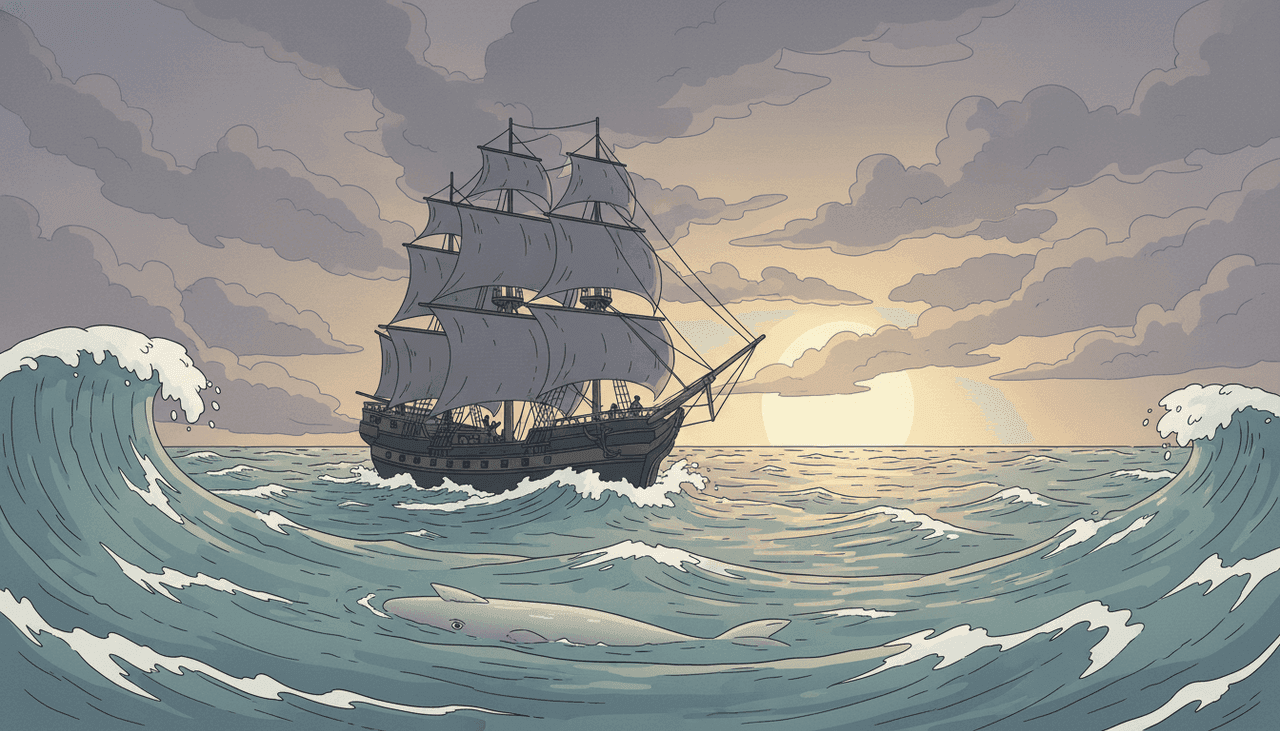
In the winter of 1850, Herman Melville bought a farmhouse in the Berkshire hills of western Massachusetts and called it Arrowhead. He was thirty-one, in debt, and already famous for cheerful sea adventures like Typee, drawn from his own years at sea and in the South Pacific. Readers wanted more of that. What he wrote instead was Moby-Dick, a huge, strange novel about a whaling captain named Ahab who hunts a white sperm whale that once took his leg. Around that chase Melville packed everything he knew about whales, work, God and obsession.
Two things pushed the book off its original course. One was his reading: he had fallen hard for Shakespeare, which is why Ahab speaks in something close to stage verse. The other was Nathaniel Hawthorne, the older novelist who lived nearby. Melville visited him, argued with him about darkness and belief, and dedicated the finished book to him. He also drew on a real disaster, the whaleship Essex, rammed and sunk by a sperm whale in 1820, and on reports of a fierce white whale sailors called Mocha Dick.
He wrote fast and under strain, upstairs at Arrowhead, shoveling snow away from the window so he could see Mount Greylock, which he said looked like a whale. The book came out in London in 1851 as The Whale, then in New York as Moby-Dick. The English edition accidentally left out the epilogue, so British reviewers complained that the story was told by a narrator who had died. Sales were poor. Melville never made a living from fiction again, and he ended his working life as a customs inspector on the New York docks.
The book was largely forgotten when he died in 1891. Then in the 1920s, around the centenary of his birth, critics rediscovered it, and it climbed to the center of American literature. Its first line, "Call me Ishmael," is one of the most quoted openings in English. A Seattle coffee company even took its name from Starbuck, Ahab's first mate. The novel that ruined its author's career now shows up on nearly every list of the great American novels.
Continue in the app
Open the app for the illustrated story of this book, the world it was written in, and the full text, a free public-domain edition, to read on screen or hear read aloud.
- ✓ The illustrated story of the book
- ✓ The world it was written in, on the map and timeline
- ✓ The full text, free, read or read aloud
Illustrations are created with AI assistance. Summaries are written with AI and reviewed by the editor. Book metadata comes from Wikidata and Open Library.