
Books ›
7th century BC · Ithaca
Odyssey
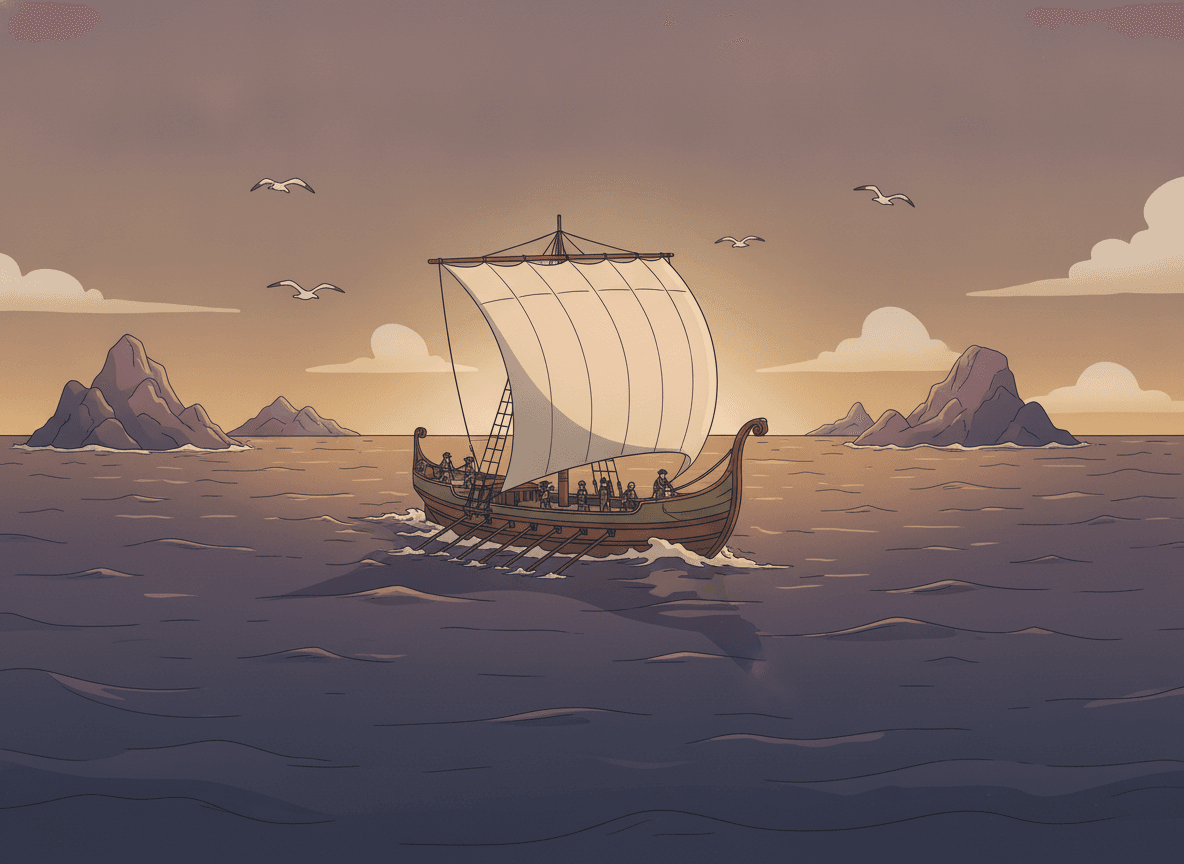
Ten years to win a war. Ten more to sail back to the woman who waited.
How this book came to be
The Odyssey is a Greek epic poem of about 12,000 lines. It follows Odysseus, a soldier trying to sail home after ten years of war, and the wife and son waiting for him. That is the anchor. The stranger story is how the poem came to exist at all.
Nobody can point to a desk where it was written. Around 700 BC, in the Greek-speaking world along the coast of Asia Minor and its islands, poetry was a performed craft. Singers called aoidoi traveled between halls and festivals, accompanied themselves on a lyre, and built their songs live from a huge stock of memorized phrases. Chios, an island off the Turkish coast, later held a guild of performers called the Homeridae, the "sons of Homer," who claimed descent from him and made Chios one of several places that fought over being his birthplace. Others claimed Smyrna, Ios, Colophon. The competition itself tells you how much prestige the name carried.
Who Homer was is genuinely unknown. Ancient tradition made him a blind bard. Scholars call the whole tangle the Homeric Question: one poet, several, or a tradition slowly hardening into a text. In the 1930s the American scholar Milman Parry went to Yugoslavia and recorded illiterate singers composing long heroic songs on the spot, using repeated set phrases exactly the way the Greek does. That fieldwork made the oral theory hard to dismiss, because it showed such a thing is humanly possible.
The poem then had an unusually lucky life. Greek cities performed it at festivals. Athens is said to have fixed an official text in the sixth century BC, though the story is disputed. Scholars in Alexandria edited it and cut it into the 24 books we still use. It was the schoolbook of the ancient Mediterranean, so a Greek child learned to read on it.
Translation carried it further. A Latin version existed by the third century BC. George Chapman's English rendering appeared in 1616, and Alexander Pope's couplets made it fashionable a century later. In 2017 Emily Wilson published the first English translation by a woman. James Joyce mapped one Dublin day onto it in Ulysses. The homecoming plot keeps returning because the question underneath it never dates: what is left of you when you finally get back?
Continue in the app
Open the app for the illustrated story of this book, the world it was written in, and the full text, a free public-domain edition, to read on screen or hear read aloud.
- ✓ The illustrated story of the book
- ✓ The world it was written in, on the map and timeline
- ✓ The full text, free, read or read aloud
Illustrations are created with AI assistance. Summaries are written with AI and reviewed by the editor. Book metadata comes from Wikidata and Open Library.