
Books ›
c. 429 BC · Thebes
Oedipus Rex
A plague, a riddle, and a man hunting the one criminal he cannot see.
How this book came to be
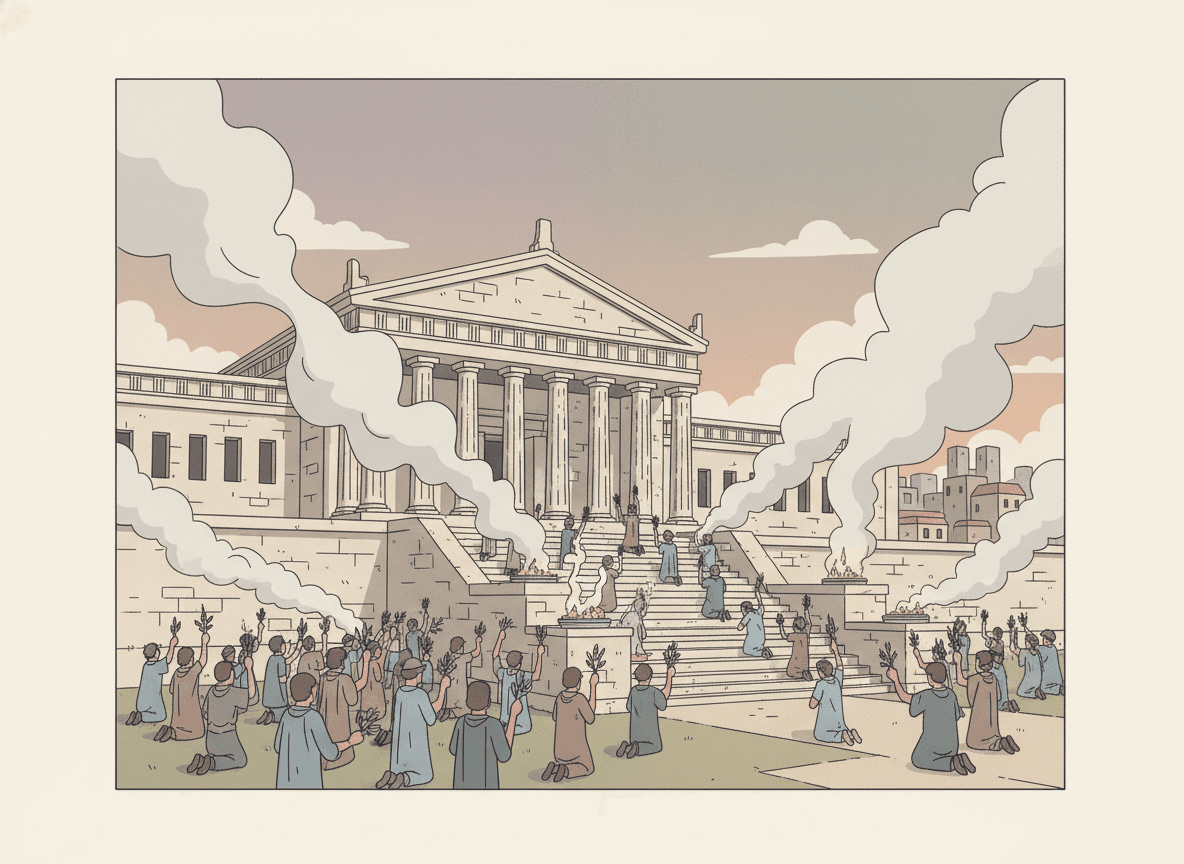
Around 429 BC, Athens was sick. A plague had swept in during the second year of the war with Sparta, killing perhaps a quarter of the city, including Pericles, the statesman who had led Athens for decades. Bodies lay in the streets. Temples filled with the dying. Into that year, or close to it, Sophocles brought a play that opens with a plague.
Sophocles was in his sixties by then, a fixture of Athenian public life. He had served as a state treasurer and as a general, and he held a priesthood connected to healing. He wrote for the City Dionysia, a yearly festival where playwrights competed before thousands of citizens packed into the open-air theatre below the Acropolis. Plays were performed once, in daylight, by masked actors and a singing chorus.
The story was not his invention. Every Athenian already knew Oedipus, the king who killed his father and married his mother without knowing who either was. That is the whole trick of the play. The audience knows. Oedipus does not. So Sophocles built the drama not as a mystery of what happened but as a manhunt in which the detective turns out to be the criminal, which meant every question the king asks brings him closer to his own ruin.
It did not win. Ancient sources say the play took second place, beaten by a poet named Philocles. Yet it outlived every play that beat it. Roughly a century later, Aristotle, the philosopher, used it in his Poetics as his central example of how tragedy should be built, praising the way recognition and reversal land in the same instant. That endorsement carried the play through the Middle Ages and the Renaissance, and it has shaped how the West argues about plot ever since.
In 1899 Sigmund Freud, the founder of psychoanalysis, borrowed the name for his theory of childhood desire, and the phrase "Oedipus complex" pushed the character into everyday speech, far past anyone who had actually read the play. Directors keep returning to it whenever a society wants to ask whether its leaders can bear the truth about themselves.
Continue in the app
Open the app for the illustrated story of this book and the world it was written in. The book itself is not included: it is still in copyright, so read it on Kindle or import your own EPUB into the app's library.
- ✓ The illustrated story of the book
- ✓ The world it was written in, on the map and timeline
- ✕ The full text is not included (in copyright)
Illustrations are created with AI assistance. Summaries are written with AI and reviewed by the editor. Book metadata comes from Wikidata and Open Library.