
Books ›
c. 1702 · Tōhoku
Oku no Hosomichi
One aging poet, fifteen hundred miles on foot, and a handful of poems that outlived him.
How this book came to be
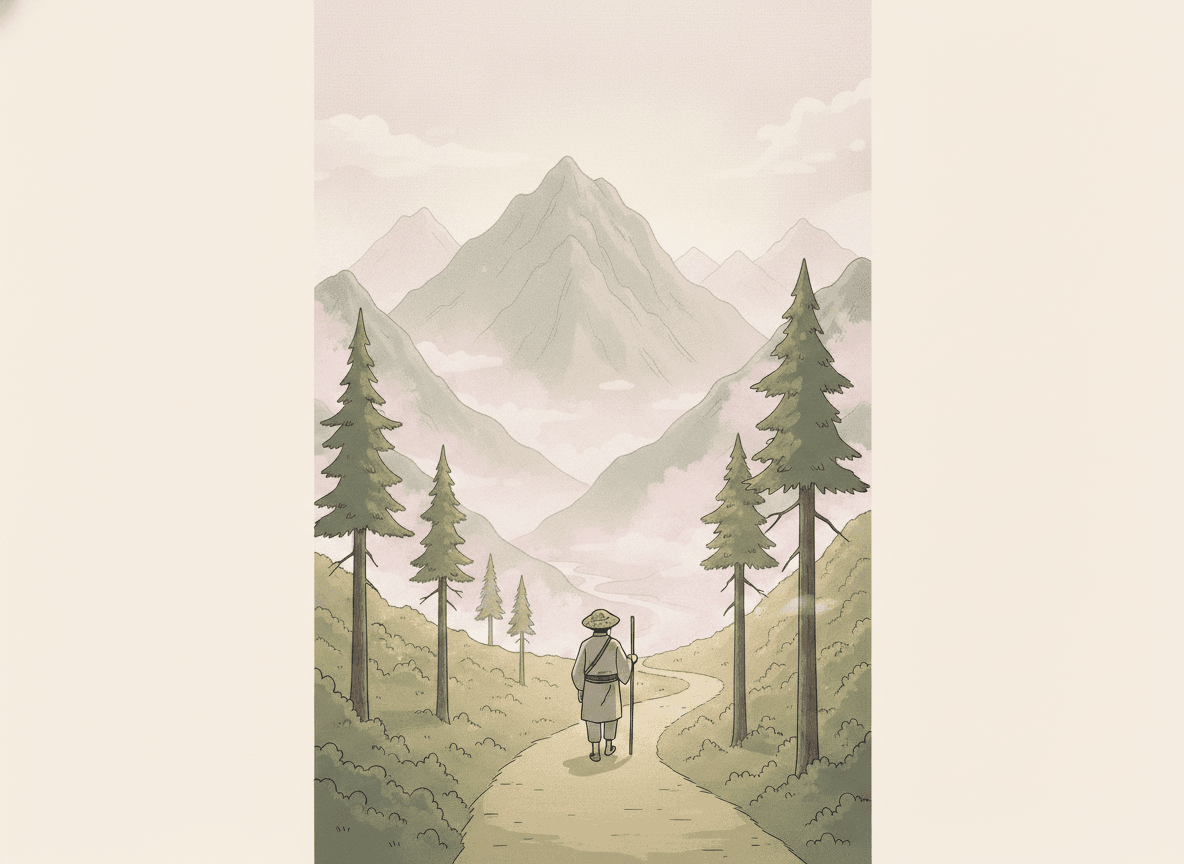
In the spring of 1689, Matsuo Bashō handed his hut in Edo (today's Tokyo) over to another family, packed very little, and set off north on foot. He was 45, already the most admired poet in Japan, and not in good health. Travel then was slow and genuinely risky, so he wrote as if he might not come back. With him went Sora, a disciple who kept his own practical diary of the trip.
The journey covered roughly 2,400 kilometers over five months, up through the northern provinces and back down the Japan Sea coast. Bashō went looking for places made famous by older poems, because in Japanese poetic tradition certain sites carried centuries of accumulated feeling. Standing where an ancient poet had stood was itself a kind of composition.
What came out of it is Oku no Hosomichi, usually translated as The Narrow Road to the Deep North. It is a haibun: short prose passages that open into haiku, the seventeen-syllable form Bashō did more than anyone to raise into serious art. It reads like a travel diary, but it is not one. Bashō spent about four more years reworking it, some of that time at his family home in Iga (his birthplace), and Sora's plainer notes show that Bashō moved events, compressed days and shaped encounters. He was after the truth of the journey rather than its schedule.
He died in 1694 with the text still unpublished. It appeared in print around 1702, and it has never gone out of favor since. Japanese schoolchildren memorize its opening lines. The route itself became a pilgrimage that people still walk, monument by monument, poem by poem.
Its influence spread far beyond Japan. When haiku reached Europe and America in the twentieth century, Bashō was the figure translators kept returning to, which is a large part of why the form is now written in dozens of languages. The book's real gift is its attitude: pay close attention, travel light, and let a small thing (a cicada, a rough sea, a summer field) carry the weight.
Continue in the app
Open the app for the illustrated story of this book and the world it was written in. The book itself is not included: it is still in copyright, so read it on Kindle or import your own EPUB into the app's library.
- ✓ The illustrated story of the book
- ✓ The world it was written in, on the map and timeline
- ✕ The full text is not included (in copyright)
Illustrations are created with AI assistance. Summaries are written with AI and reviewed by the editor. Book metadata comes from Wikidata and Open Library.