
Books ›
1967 · Aracataca
One Hundred Years of Solitude
Seven generations, one town in the jungle, and a family that keeps living the same lives over again.
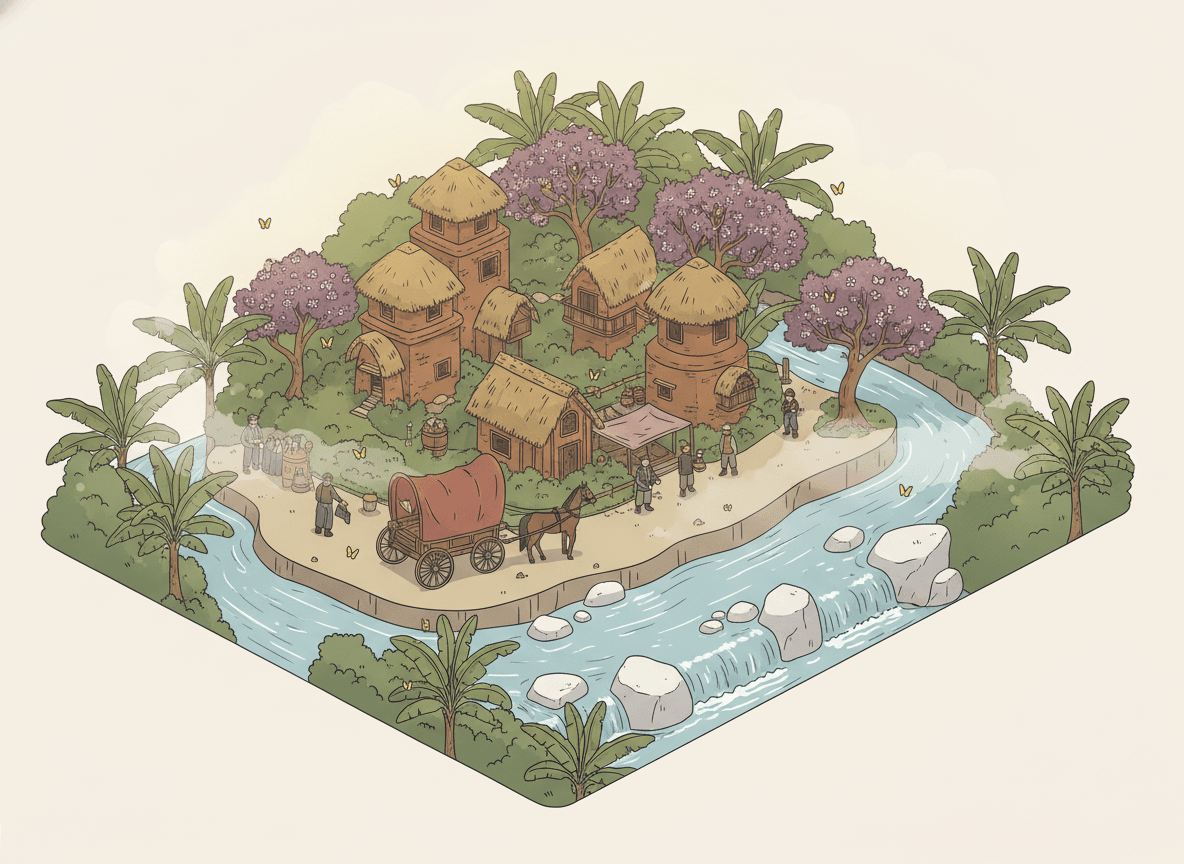
How this book came to be
In 1965 Gabriel García Márquez was driving his family from Mexico City toward Acapulco for a holiday when, by his own account, the whole shape of a novel arrived at once. He turned the car around and went home to write it.
He was thirty-eight, a Colombian journalist and screenwriter living in Mexico, and he had published books that almost nobody bought. For roughly eighteen months he shut himself in a room and worked. The family lived on credit. His wife, Mercedes Barcha, held off the landlord and the butcher, and household things went to the pawnshop, including, at the end, the car.
The book is a novel about the Buendía family and the town of Macondo across seven generations, told in a voice where ghosts, plagues of insomnia and a woman rising into the sky are reported as calmly as the weather. That deadpan tone came from home. His grandmother, Tranquilina Iguarán, had told him impossible things with a completely straight face when he was a boy in Aracataca, the banana town on Colombia's Caribbean coast. His grandfather, Colonel Nicolás Márquez, a veteran of Colombia's civil wars, gave him the other half: soldiers, old grievances, and the 1928 massacre of striking banana workers, a real killing that the novel absorbs.
When the manuscript was finished, the couple famously could not afford to mail all of it to the publisher in Buenos Aires and sent it in parts. Editorial Sudamericana published Cien años de soledad in June 1967. The first printing of about eight thousand copies vanished within weeks, which almost nobody had expected, and reprint followed reprint across Latin America.
The novel became the engine of the Latin American "Boom", the moment when the continent's writers found a world audience. Gregory Rabassa's English translation appeared in 1970 and García Márquez said he preferred it to his own text. Translations now run past forty languages and sales past fifty million copies. In 1982 he won the Nobel Prize in Literature. Writers from Toni Morrison to Salman Rushdie have pointed back to this book as permission: you may tell the truth about your own place in the voice your grandmother used.
Continue in the app
Open the app for the illustrated story of this book and the world it was written in. The book itself is not included: it is still in copyright, so read it on Kindle or import your own EPUB into the app's library.
- ✓ The illustrated story of the book
- ✓ The world it was written in, on the map and timeline
- ✕ The full text is not included (in copyright)
Illustrations are created with AI assistance. Summaries are written with AI and reviewed by the editor. Book metadata comes from Wikidata and Open Library.