
Books ›
1719 · Orinoco River
Robinson Crusoe
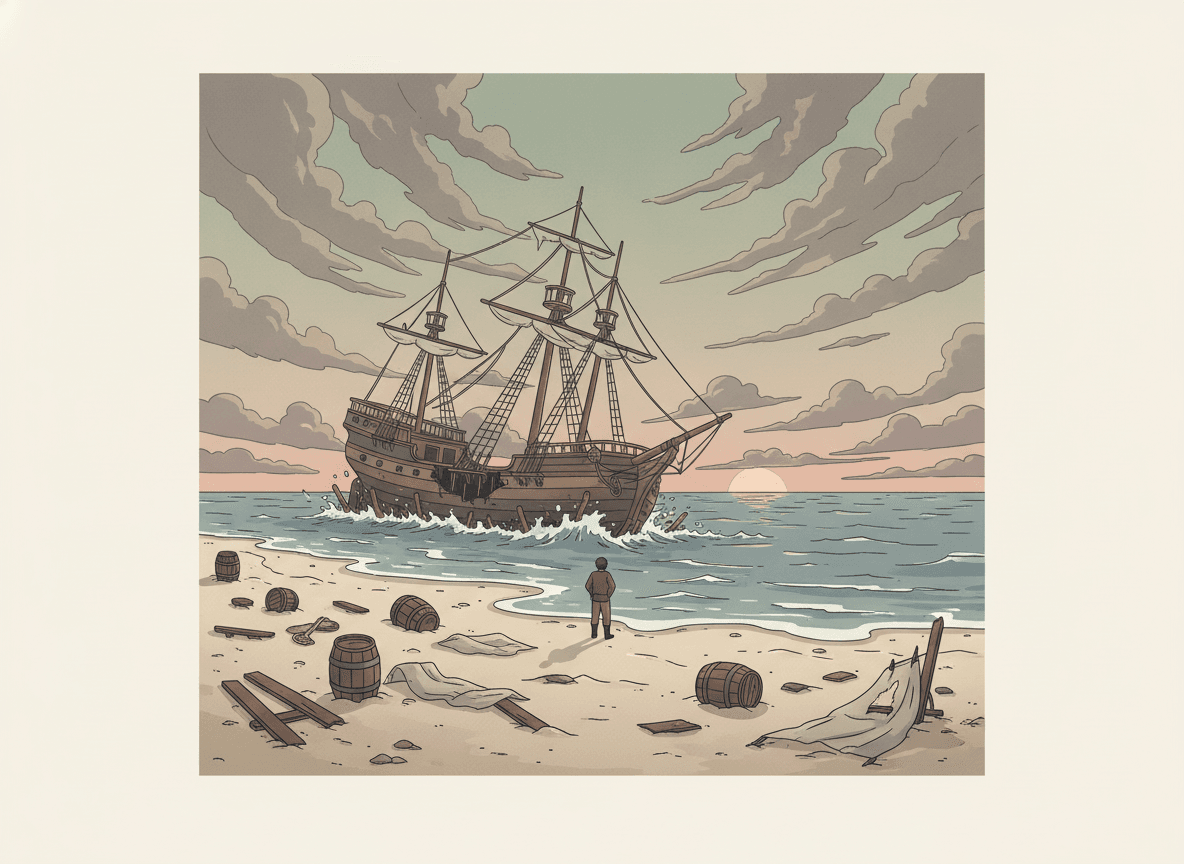
One sailor, one island, and a whole world built from a wrecked ship's leftovers.
How this book came to be
In April 1719, a London printer named William Taylor put out a book with an enormous title and no author's name on it. It claimed to be the true memoir of a sailor from York who spent twenty-eight years alone on an island. The man who actually wrote it was Daniel Defoe, and he was about fifty-nine years old, which was old for a first novel.
Defoe had lived a loud, bruised life before that. He was a merchant who went bankrupt, a brick maker, a political writer, and a government agent who gathered intelligence in Scotland. In 1703 he was put in the pillory and jailed for a satirical pamphlet that mocked the persecution of Dissenters, the Protestants who refused to join the Church of England. Defoe was one of them. So he knew what it meant to be an outsider, and he knew how to write fast for money.
The spark most often named is Alexander Selkirk, a Scottish sailor who was left on an island off Chile and lived there more than four years before a passing ship picked him up in 1709. His story was famous in London. Defoe almost certainly knew it, though there is no proof the two men ever met, and Crusoe's island and his years of trade and slavery are Defoe's invention.
Readers took it seriously, partly because it was written as a plain first-person account with dates and inventories. It sold fast. Four editions appeared within a year, and pirated versions followed, which annoyed Defoe enough that he complained in print. He rushed out a sequel the same year and a third volume in 1720.
The afterlife is bigger than the book. In Emile, the philosopher Jean-Jacques Rousseau made it the one novel he would allow a child to read. German writers produced so many imitations that they earned a name, Robinsonades. Economists borrowed "Robinson Crusoe" as shorthand for a lone person making choices. Later readers pushed back hard on the colonial shape of the story, especially Crusoe's relationship with Friday. Nobel winner Derek Walcott and novelist J. M. Coetzee both rewrote it from the other side.
Continue in the app
Open the app for the illustrated story of this book, the world it was written in, and the full text, a free public-domain edition, to read on screen or hear read aloud.
- ✓ The illustrated story of the book
- ✓ The world it was written in, on the map and timeline
- ✓ The full text, free, read or read aloud
Illustrations are created with AI assistance. Summaries are written with AI and reviewed by the editor. Book metadata comes from Wikidata and Open Library.