
Books ›
977 to 1010 · Sistan
Shahnameh
Thirty years, fifty thrones, and one poet who built a palace out of words.
How this book came to be
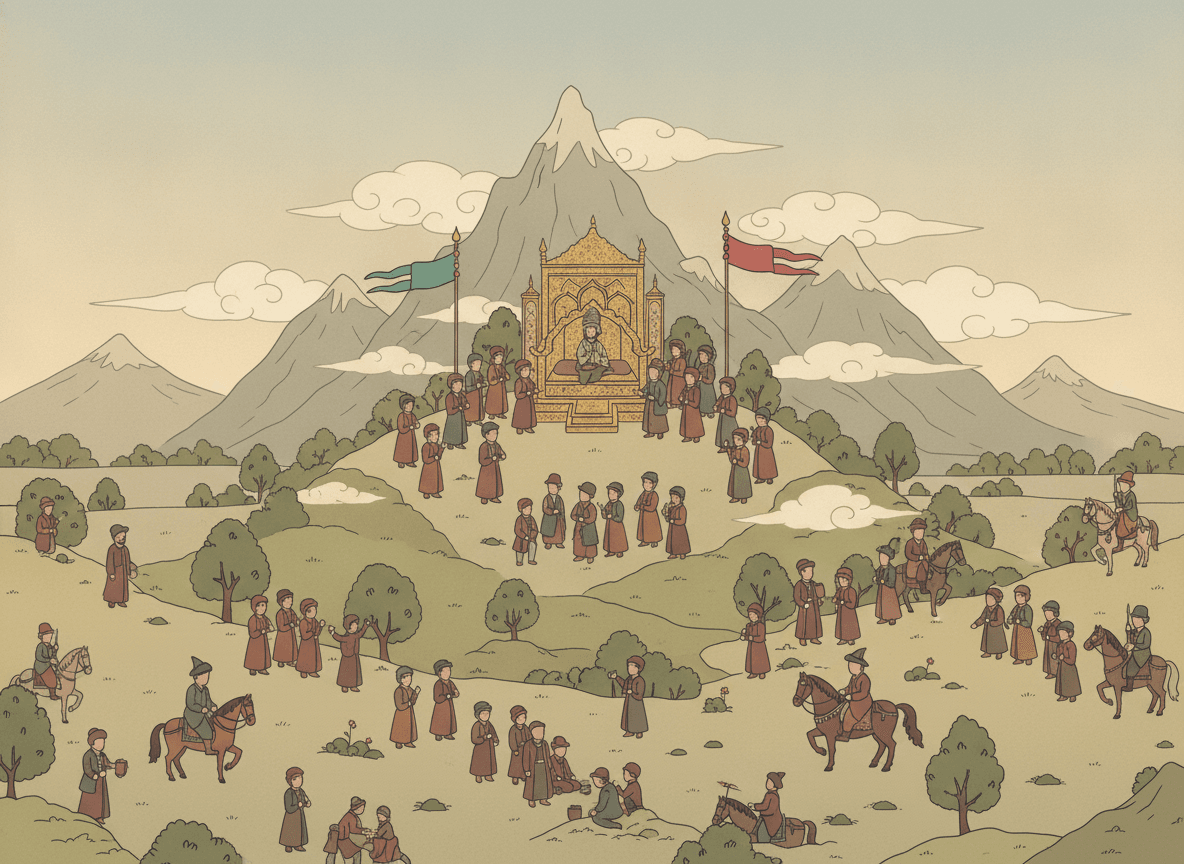
The Shahnameh, or Book of Kings, is a Persian epic poem of roughly 50,000 rhyming couplets. It tells the history of Iran from the first king to the Arab conquest of the seventh century, mixing myth, legend and remembered history.
Its author, Ferdowsi, was a landowner from Tus, in what is now northeastern Iran. He began the work around 977 and finished it in 1010, more than thirty years later. He was not starting from nothing. An earlier poet, Daqiqi, had begun a verse Book of Kings and was murdered after completing about a thousand lines. Ferdowsi kept those lines in his own poem and credited them, then carried the story on himself. He worked from older prose collections of Iranian legend, which had been gathered from earlier sources.
The decades he wrote in were unsettled. Persian-speaking lands were passing from local Iranian dynasties to Turkic rulers, and Arabic was the prestige language of learning. Ferdowsi wrote in Persian, and he leaned hard on Persian vocabulary. Because he did, the poem became a reservoir of the language and of Iranian memory at exactly the moment both might have thinned out.
He dedicated the finished work to Mahmud of Ghazni, the Turkic sultan whose empire then covered the region. The famous story says Mahmud paid him poorly and that Ferdowsi died bitter and unrewarded, with the sultan's gift arriving too late. That account comes from later biographers and cannot be verified, so it is best treated as legend rather than fact.
The afterlife was enormous. The Shahnameh was copied, recited and illustrated for a thousand years. Persian, Mughal and Ottoman workshops produced illuminated manuscripts of it, including the sixteenth-century Shah Tahmasp copy, one of the most lavish books ever made. Professional storytellers performed episodes in teahouses. Its heroes, above all Rostam, the great champion, became household names across Iran, Afghanistan, Tajikistan and beyond. Iranians today can still read it with far less difficulty than English readers face with Chaucer, which tells you how much of the language it helped hold in place.
Continue in the app
Open the app for the illustrated story of this book and the world it was written in. The book itself is not included: it is still in copyright, so read it on Kindle or import your own EPUB into the app's library.
- ✓ The illustrated story of the book
- ✓ The world it was written in, on the map and timeline
- ✕ The full text is not included (in copyright)
Illustrations are created with AI assistance. Summaries are written with AI and reviewed by the editor. Book metadata comes from Wikidata and Open Library.