
Books ›
4th century BC · Luoyang
Tao Te Ching
A book of five thousand characters, coaxed from a sage at a mountain pass, on the Way that cannot be named.
How this book came to be
The Tao Te Ching is a slim book of about 5,000 Chinese characters, arranged in 81 short chapters that read more like poems than arguments. It circles around one word, dao, meaning "the way": the pattern that things follow when nobody forces them. Its most famous advice is wu wei, acting without strain, the way water gets around a rock by going where the rock is not.
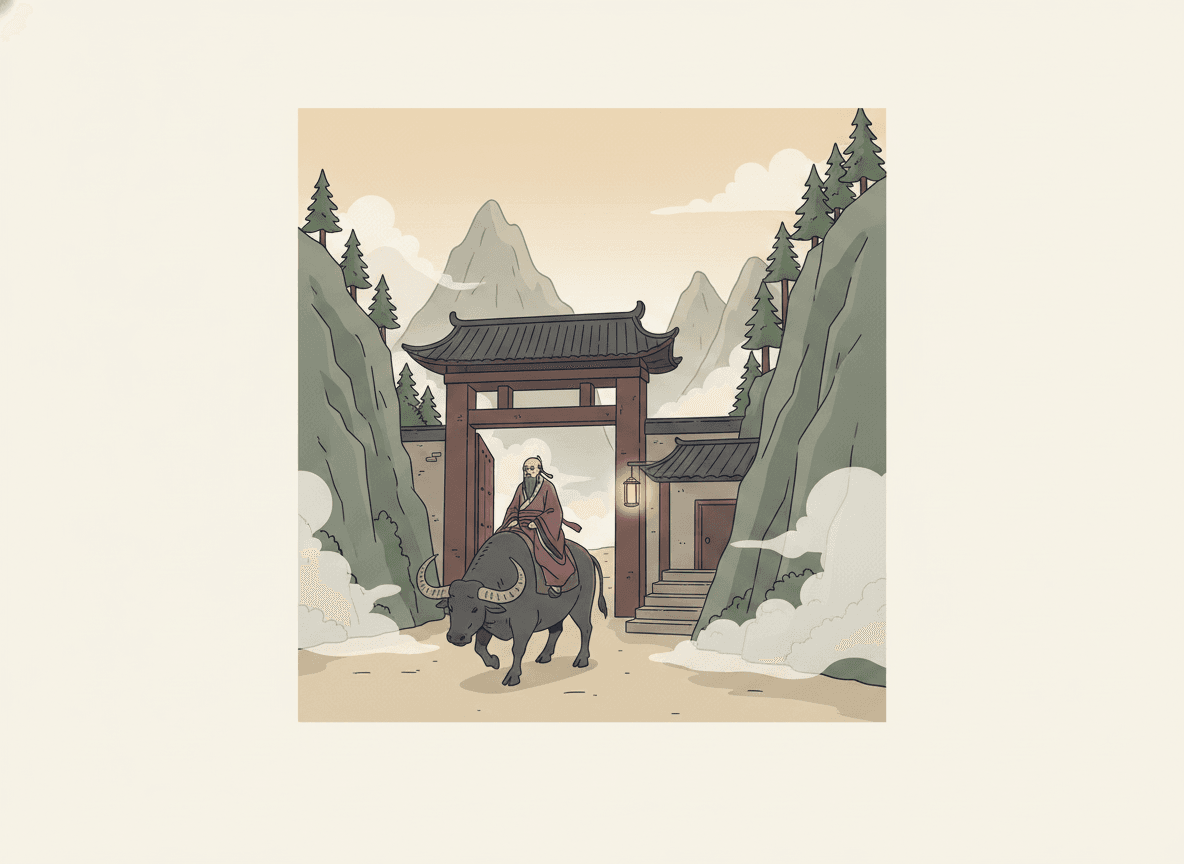
Who wrote it is a genuine puzzle. Tradition names Laozi (the name simply means "Old Master"), described as an archivist in the royal library of the Zhou kings at Luoyang, and supposedly an older contemporary of Confucius. The legend, recorded centuries later by the historian Sima Qian, is lovely: sickened by the decay of the court, the old man rode west to leave China for good. At the Hangu Pass, the gatekeeper recognized him and refused to let him through until he wrote his wisdom down. He wrote the book, handed it over, and vanished. Sima Qian himself hedged on the details, so this is legend rather than record.
Most scholars now read the text as a compilation, layered over generations of teachers and finally settled around the fourth century BC. That was the Warring States period, when rival kingdoms fought almost continuously and thinkers competed to tell rulers how to govern. Because everyone else was proposing more ritual, more law, more control, a book advising rulers to do less landed as a real argument, not a retreat.
It survived remarkably well. In 1973, archaeologists at Mawangdui unearthed two silk copies from a tomb sealed in the second century BC, with the two halves of the book in reverse order. In 1993 at Guodian, bamboo slips from around 300 BC turned up carrying an even older partial version. Each find pushed the text further back and showed it was still moving.
Its afterlife is enormous. It became a founding scripture of religious Daoism, shaped Chan Buddhism and later Zen, and is now among the most translated books on earth, second only to the Bible by most counts. Readers keep coming back because it does not tell you what to do. It tells you to stop pushing.
Continue in the app
Open the app for the illustrated story of this book and the world it was written in. The book itself is not included: it is still in copyright, so read it on Kindle or import your own EPUB into the app's library.
- ✓ The illustrated story of the book
- ✓ The world it was written in, on the map and timeline
- ✕ The full text is not included (in copyright)
Illustrations are created with AI assistance. Summaries are written with AI and reviewed by the editor. Book metadata comes from Wikidata and Open Library.