
Books ›
c. 1387 to 1400 · Canterbury
The Canterbury Tales
Chaucer's pilgrims: all of medieval England on one muddy road
How this book came to be
Geoffrey Chaucer was not a full-time poet. He was a customs official, a diplomat, a member of the royal household, a man who counted wool sacks on the London docks and carried messages to Italy for the king. He began The Canterbury Tales around 1387, in his forties, after decades of watching English life from the inside of its bureaucracy.
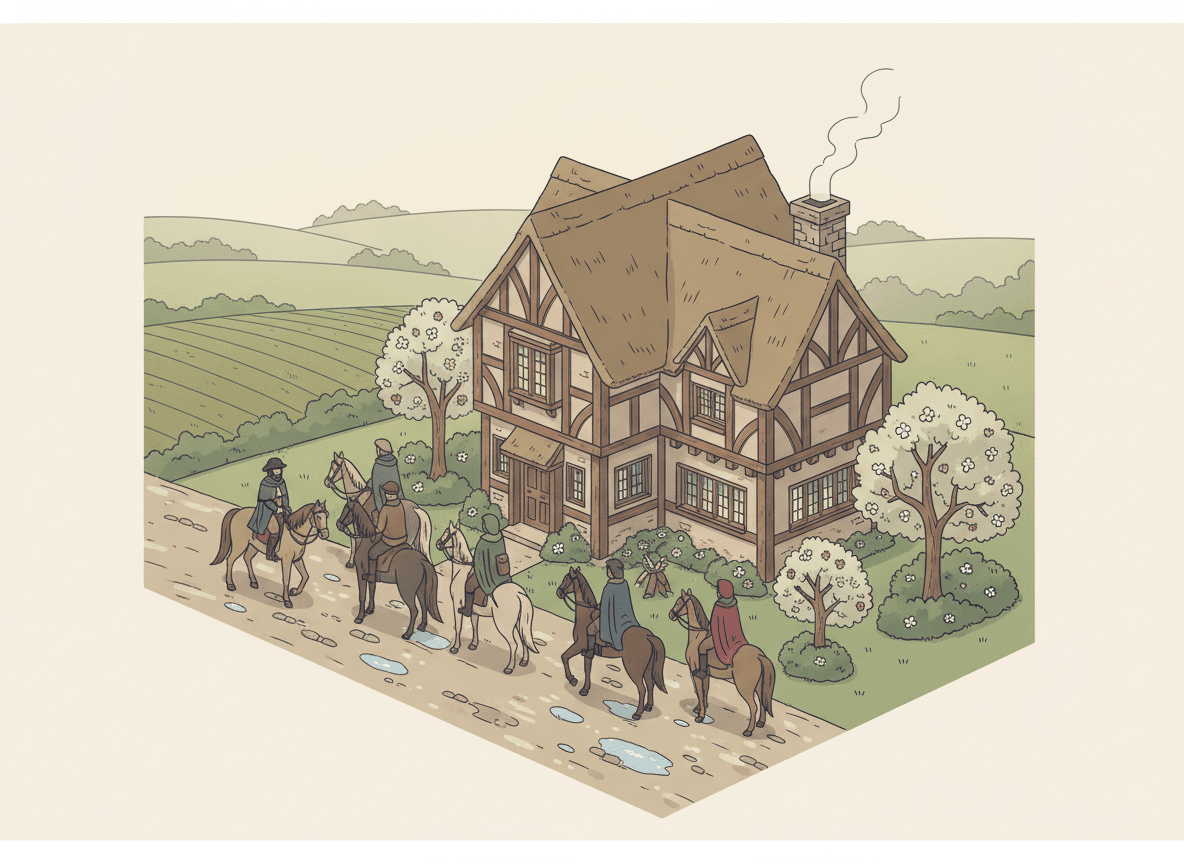
The frame is simple and brilliant. Thirty or so pilgrims meet at the Tabard Inn in Southwark and ride toward the shrine of Thomas Becket at Canterbury. To pass the time, they tell stories. A knight, a miller, a cook, a widow from Bath who has buried five husbands: each gets a voice, and each voice sounds different. That was the trick nobody in England had pulled off before.
Chaucer wrote in English, and that choice mattered enormously. The court still spoke French. Scholars wrote Latin. English was the language of the street, thought too rough for serious literature. Chaucer used it anyway, in the London dialect he heard every day, which is one reason that dialect became the ancestor of the English we speak now.
He never finished. The plan called for each pilgrim to tell four tales; he completed twenty-four, some of them fragments, and the order of the pieces is still argued over because the manuscripts disagree. He died in 1400 with the work incomplete.
It survived anyway. More than eighty medieval manuscripts of the Tales exist, an enormous number, which tells us people kept copying it because people kept wanting it. In 1476 William Caxton printed it on England's first printing press, making it one of the first books ever printed in English. The bawdy tales got censored in later centuries; the Miller's story was quietly dropped from schoolroom editions for generations.
Today the Tales are read as the closest thing we have to a recording of medieval England talking. Not kings and saints, but a cook with a sore on his leg and a pardoner selling fake relics. Chaucer was buried in Westminster Abbey, and other writers were later buried near him. That corner is now called Poets' Corner.
Continue in the app
Open the app for the illustrated story of this book, the world it was written in, and the full text, a free public-domain edition, to read on screen or hear read aloud.
- ✓ The illustrated story of the book
- ✓ The world it was written in, on the map and timeline
- ✓ The full text, free, read or read aloud
Illustrations are created with AI assistance. Summaries are written with AI and reviewed by the editor. Book metadata comes from Wikidata and Open Library.