
Books ›
c. 1177 · Nishapur
The Conference of the Birds
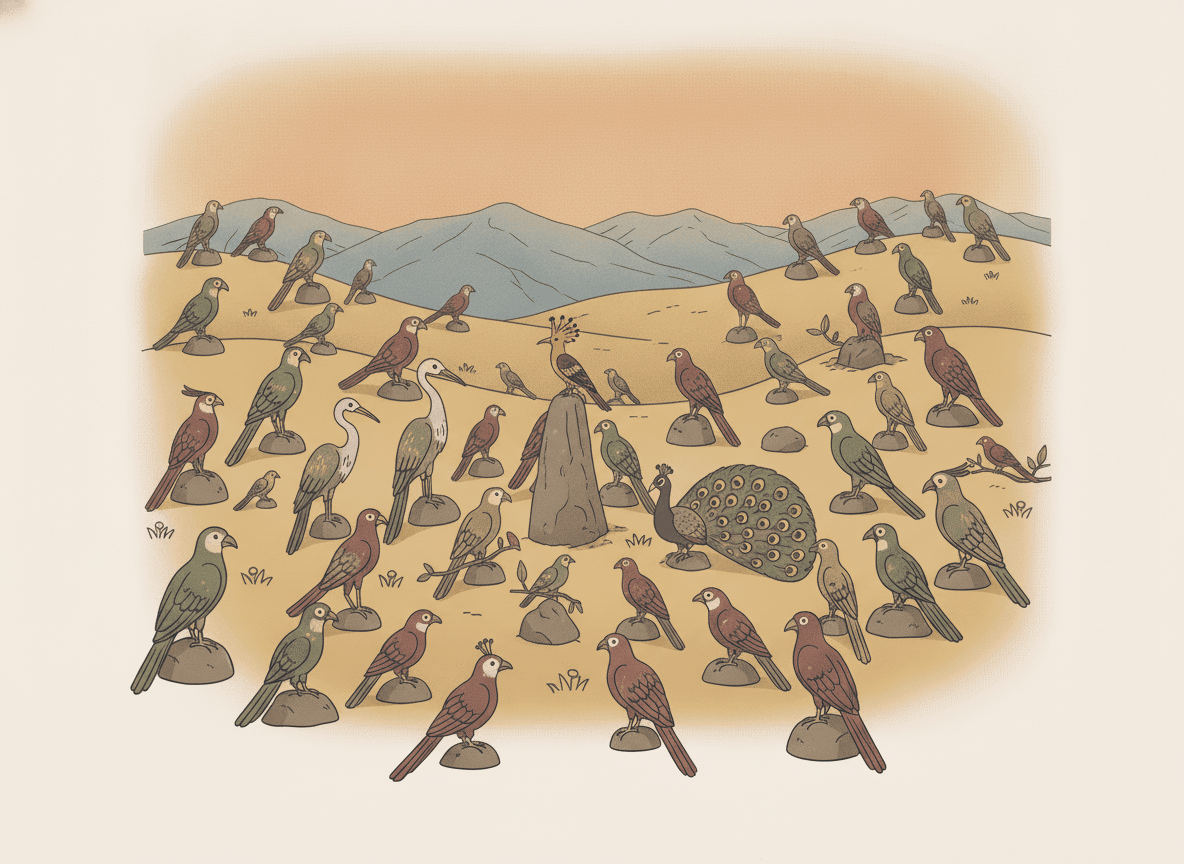
All the birds of the world set out to find their king. Only a handful arrive.
How this book came to be
Around 1177, in the trading city of Nishapur in northeastern Iran, a pharmacist sat among his jars and wrote one of the strangest poems ever made. Farid ud-Din Attar ran an attar shop, which is where his name comes from: a seller of perfumes and medicines. Patients came in all day with their pains and their stories. He listened, mixed remedies, and in the quiet hours wrote verse.
Manṭiq al-Ṭayr, usually called The Conference of the Birds, is a long allegorical poem in Persian. All the birds of the world gather to seek a king, and the hoopoe leads them on a journey across seven valleys toward a mysterious sovereign called the Simurgh. That frame carries dozens of short tales tucked inside it, the way a merchant packs small boxes into a larger one.
Attar was writing inside Sufism, the mystical current within Islam that treats love of God as a journey the soul actually walks. He did not invent the birds. Earlier Persian and Arabic writers had used bird assemblies before him, and the Simurgh was already an old figure in Iranian myth. What Attar did was give the idea a shape long enough and human enough to hold everything he knew about longing, fear and excuse-making.
His city did not survive him well. Nishapur was devastated by the Mongol invasion in 1221, and tradition says Attar died in that catastrophe, though the details told about his death are legend rather than documented fact.
The poem outlived the ruins. Persian readers copied it for centuries, and later manuscripts were illuminated by some of the finest painters of the Islamic world. Rumi, the great Persian poet of the next generation, spoke of Attar with open reverence and clearly learned from him. In modern times the poem became theatre: Peter Brook and Jean-Claude Carrière turned it into a celebrated stage production in 1979, which brought it to audiences who had never read a line of Persian verse. It is still one of the works people reach for when they want to explain what Sufi poetry is trying to do.
Continue in the app
Open the app for the illustrated story of this book and the world it was written in. The book itself is not included: it is still in copyright, so read it on Kindle or import your own EPUB into the app's library.
- ✓ The illustrated story of the book
- ✓ The world it was written in, on the map and timeline
- ✕ The full text is not included (in copyright)
Illustrations are created with AI assistance. Summaries are written with AI and reviewed by the editor. Book metadata comes from Wikidata and Open Library.