
Books ›
1831 · Paris
The Hunchback of Notre Dame
Victor Hugo's tragedy of outcasts, and the novel that saved a cathedral
How this book came to be
In 1830, Victor Hugo was twenty-eight and already famous in Paris. He was also late. He had signed a contract for a novel about medieval Paris and kept missing the deadline, so his publisher, Charles Gosselin, threatened him with a fine for every week he ran over. Hugo shut himself in, bought a bottle of ink, and worked through the autumn. He finished in January 1831, and the book came out that March.
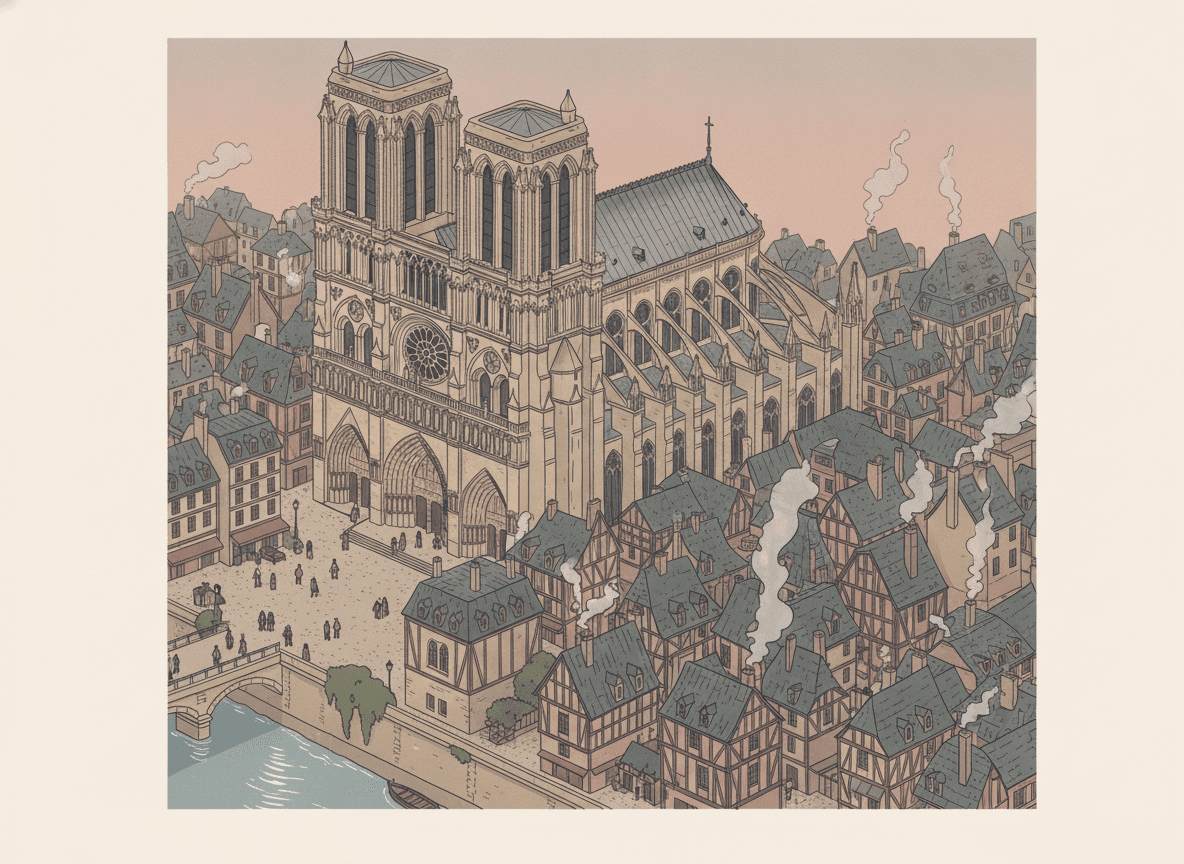
He had a cause. Paris was tearing down or mutilating its old buildings, and the cathedral of Notre-Dame was in poor shape: scarred by revolutionary vandalism, whitewashed, its statues broken. Hugo loved Gothic architecture and thought France was destroying its own memory. So he wrote a novel in which the building itself is a main character. The story, set in 1482, follows Quasimodo, the deaf bell-ringer who lives in the towers, Esmeralda, a young dancer, and Claude Frollo, the archdeacon whose obsession with her drives the tragedy. Around them Hugo rebuilt a whole vanished city, street by street.
The timing helped. The July Revolution of 1830 had just replaced one king with another, and readers were hungry for a French past that felt theirs. The novel sold fast and was translated quickly, which is where the English title The Hunchback of Notre-Dame comes from. Hugo disliked it, because his title puts the cathedral first.
The effect on the real building was extraordinary. Public opinion shifted, money was found, and in 1844 the architects Eugène Viollet-le-Duc and Jean-Baptiste Lassus began a long restoration. The famous spire that burned in April 2019 was theirs, not the Middle Ages'. In the days after that fire, Hugo's novel shot back onto bestseller lists in France.
Since then the book has been filmed, staged, danced and sung more times than almost any other French novel, from Lon Chaney's silent Quasimodo in 1923 to a Disney animated film in 1996. Readers who have never opened it still know the towers, the bells, and the man who rings them.
Continue in the app
Open the app for the illustrated story of this book and the world it was written in. The book itself is not included: it is still in copyright, so read it on Kindle or import your own EPUB into the app's library.
- ✓ The illustrated story of the book
- ✓ The world it was written in, on the map and timeline
- ✕ The full text is not included (in copyright)
Illustrations are created with AI assistance. Summaries are written with AI and reviewed by the editor. Book metadata comes from Wikidata and Open Library.