
Books ›
1010s · Kyoto
The Tale of Genji
Murasaki Shikibu's Shining Prince: the world's first psychological novel
How this book came to be
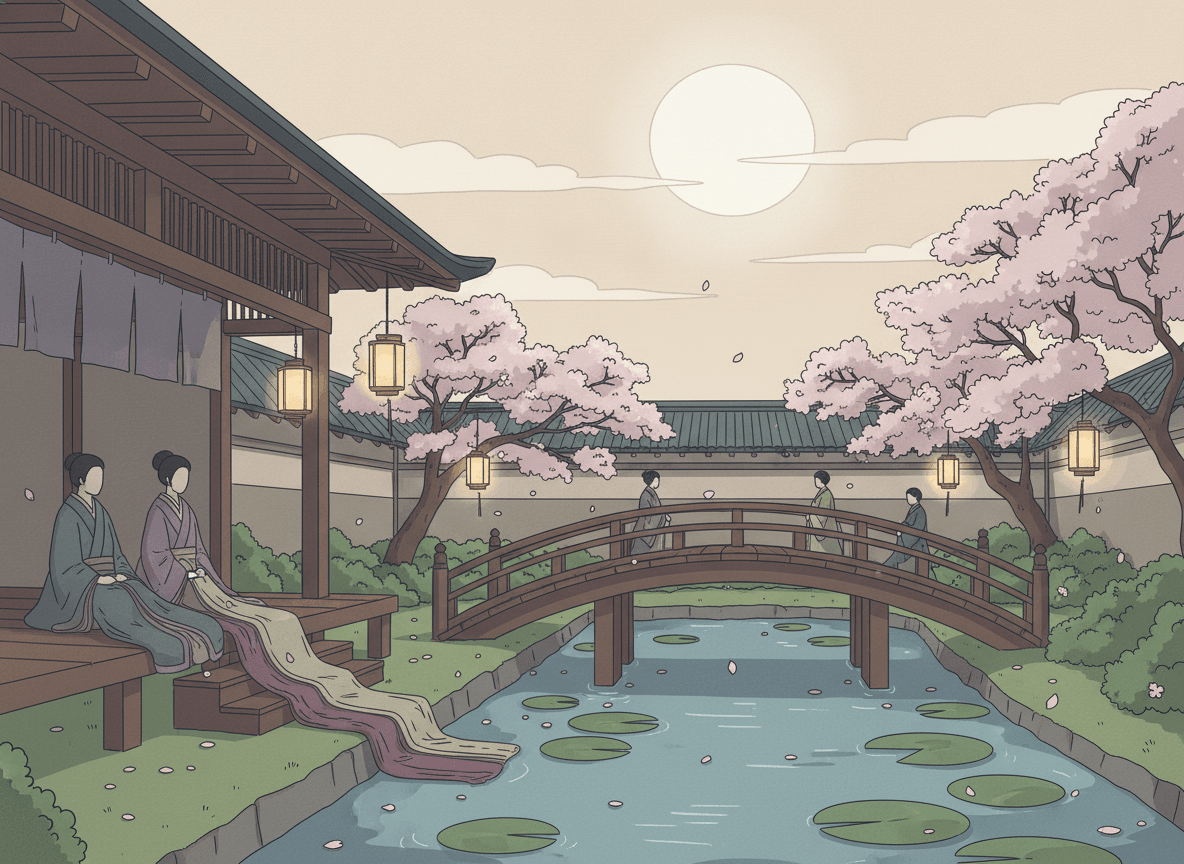
Around the year 1010, in the imperial court at Heian-kyo (today's Kyoto), a woman we know only by a nickname was writing what many consider the world's first novel. Murasaki Shikibu was not her real name. "Shikibu" came from her father's post in the Bureau of Ceremonial, and "Murasaki" (which means purple) was borrowed from a character in her own book. Women of her rank were rarely recorded by name.
She was a widow. Her husband, a much older provincial official, had died a few years into their marriage, leaving her with a small daughter and a great deal of time. Her father had taught her Chinese classics, which was unusual, because Chinese was considered men's learning. She later wrote in her diary that she had to hide how much she knew.
The Tale of Genji is a long prose story about Hikaru Genji, the gifted son of an emperor who is demoted to commoner status, and about the women whose lives cross his. It runs to fifty-four chapters and follows several generations.
Murasaki wrote it in installments, in Japanese script rather than Chinese, and it circulated by hand among court women who copied and passed it along chapter by chapter. That popularity got her noticed. She was summoned to serve Empress Shoshi, and the court itself became her material and her audience.
No manuscript in her hand survives. The oldest complete copies date from centuries later, and scholars still argue over whether she wrote every chapter. What is not disputed is the book's afterlife. It became required reading for poets, who mined it for allusions. It shaped painting, incense games, screen art and Noh theatre. Illustrated handscrolls of it, made in the twelfth century, are among Japan's national treasures.
For most of a thousand years it stayed a Japanese classic. Then Arthur Waley's English translation appeared in the 1920s and Western readers met it as a novel, comparable to Proust in its patience and psychological detail. It has been translated into English several times since, each version arguing with the last about how to render a court where people are named by their titles and speak mostly in poems.
Continue in the app
Open the app for the illustrated story of this book, the world it was written in, and the full text, a free public-domain edition, to read on screen or hear read aloud.
- ✓ The illustrated story of the book
- ✓ The world it was written in, on the map and timeline
- ✓ The full text, free, read or read aloud
Illustrations are created with AI assistance. Summaries are written with AI and reviewed by the editor. Book metadata comes from Wikidata and Open Library.