
Books ›
1958 · Ogidi
Things Fall Apart
A strong man, a proud village, and the year the ground tilted beneath them.
How this book came to be
In the early 1950s, a young Nigerian named Chinua Achebe was studying at University College, Ibadan, when he read Joyce Cary's novel Mister Johnson, set in Nigeria. It was praised in Britain. To Achebe it read as a caricature, an African country described entirely from outside. He later said that was the moment he understood the story of his people would have to be written by his people.
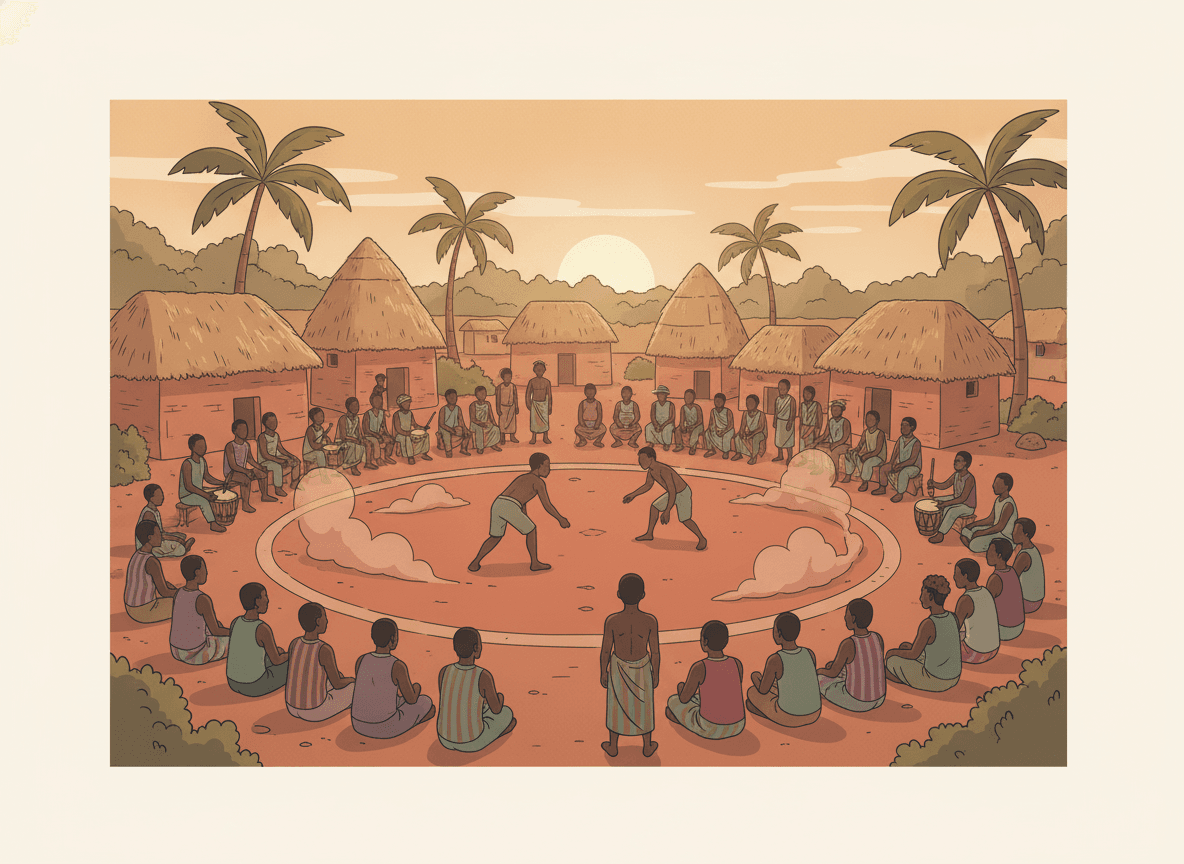
Achebe grew up in Ogidi, in southeastern Nigeria, in an Igbo family that had converted to Christianity. So he lived with one foot in each world: the church and the English schoolroom on one side, the proverbs, festivals and elders of Igbo tradition on the other. He wrote Things Fall Apart in the mid-1950s while working for the Nigerian Broadcasting Service in Lagos, in his own time, in longhand. The novel follows Okonkwo, a proud and respected wrestler and farmer in an Igbo village, as British missionaries and colonial administrators arrive and the world he knows loses its footing. The title comes from a line in the poem The Second Coming by the Irish poet W. B. Yeats.
Getting it published was almost a disaster. Achebe sent his only manuscript to a London typing agency, and it sat there ignored for months. It came back only after his boss, on a trip to London, went to the office in person to demand it. Heinemann published the book in 1958 and printed just 2,000 hardback copies, unsure anyone would want a novel about village life in Nigeria.
They were wrong. Nigeria became independent in 1960, and across Africa readers found in the book a past described from the inside, with its own laws, humor and arguments, rather than as a blank space waiting for Europeans. It became the founding text of Heinemann's African Writers Series, which Achebe himself edited for years and which brought a generation of African novelists into print. It has since been translated into more than fifty languages and sold many millions of copies, and it sits on school syllabuses on every continent.
Continue in the app
Open the app for the illustrated story of this book and the world it was written in. The book itself is not included: it is still in copyright, so read it on Kindle or import your own EPUB into the app's library.
- ✓ The illustrated story of the book
- ✓ The world it was written in, on the map and timeline
- ✕ The full text is not included (in copyright)
Illustrations are created with AI assistance. Summaries are written with AI and reviewed by the editor. Book metadata comes from Wikidata and Open Library.