
Books ›
1869 · Mariinsky Hospital for the Poor
War and Peace
Five families, one war, and every small choice that moves history.
How this book came to be
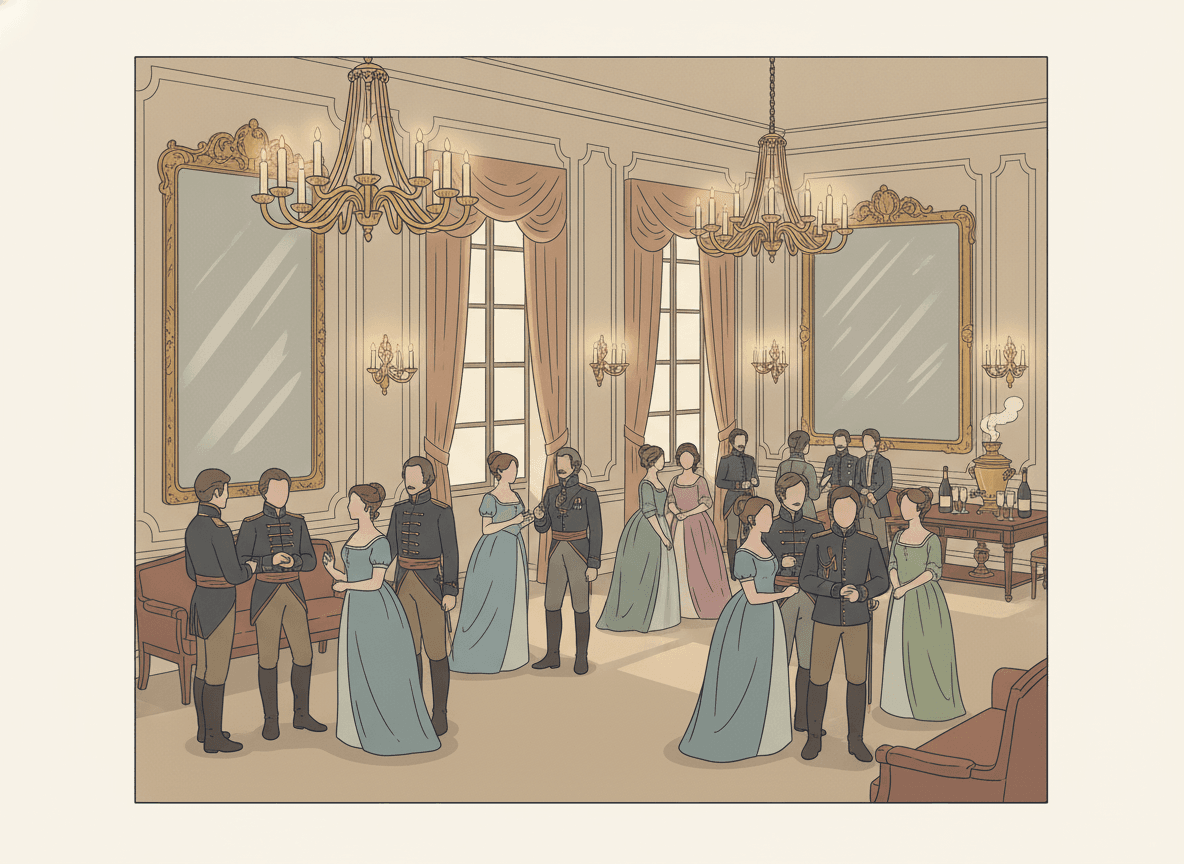
Leo Tolstoy was in his thirties, newly married, and settled at Yasnaya Polyana, the family estate south of Moscow, when he began the book that became War and Peace. He had already fought in the Crimean War and written about it, so the noise and confusion of battle were things he knew firsthand rather than from books. He started out wanting to write about the Decembrists, the officers who staged a failed revolt against the Tsar in 1825. To explain those men, he kept reaching further back, to the Napoleonic wars that had formed them. The novel grew backwards into its own origins.
What he produced is a huge prose work about Russian families living through Napoleon's invasion of 1812, mixed with essays on how history actually works. Tolstoy insisted it was not a novel at all, and said so in print. He read memoirs, walked the battlefield at Borodino, and questioned survivors, because he wanted the texture of the period to be right.
It appeared first in pieces. From 1865 the Russian journal Russkiy Vestnik published installments under the title 1805, and the complete work came out in book form by 1869. His wife, Sofya Tolstaya, copied out drafts by hand, and the story that she recopied the whole manuscript seven times is often repeated but hard to verify. Readers argued about it immediately. Some veterans disputed his account of the campaign, and critics complained about the long passages where the author steps forward to argue about free will and the causes of events.
It won anyway. Translations spread across Europe, and by the twentieth century the book had become a byword for scale and ambition in fiction. Filmmakers kept trying it, most famously Sergei Bondarchuk, whose Soviet version of the 1960s used enormous numbers of extras and won an Academy Award. Writers from Virginia Woolf onward measured themselves against it. Its central argument still lands: that history is not made by great men issuing orders, but by countless ordinary people whose small choices nobody records.
Continue in the app
Open the app for the illustrated story of this book, the world it was written in, and the full text, a free public-domain edition, to read on screen or hear read aloud.
- ✓ The illustrated story of the book
- ✓ The world it was written in, on the map and timeline
- ✓ The full text, free, read or read aloud
Illustrations are created with AI assistance. Summaries are written with AI and reviewed by the editor. Book metadata comes from Wikidata and Open Library.