
Books ›
1879 · Oslo
A Doll's House
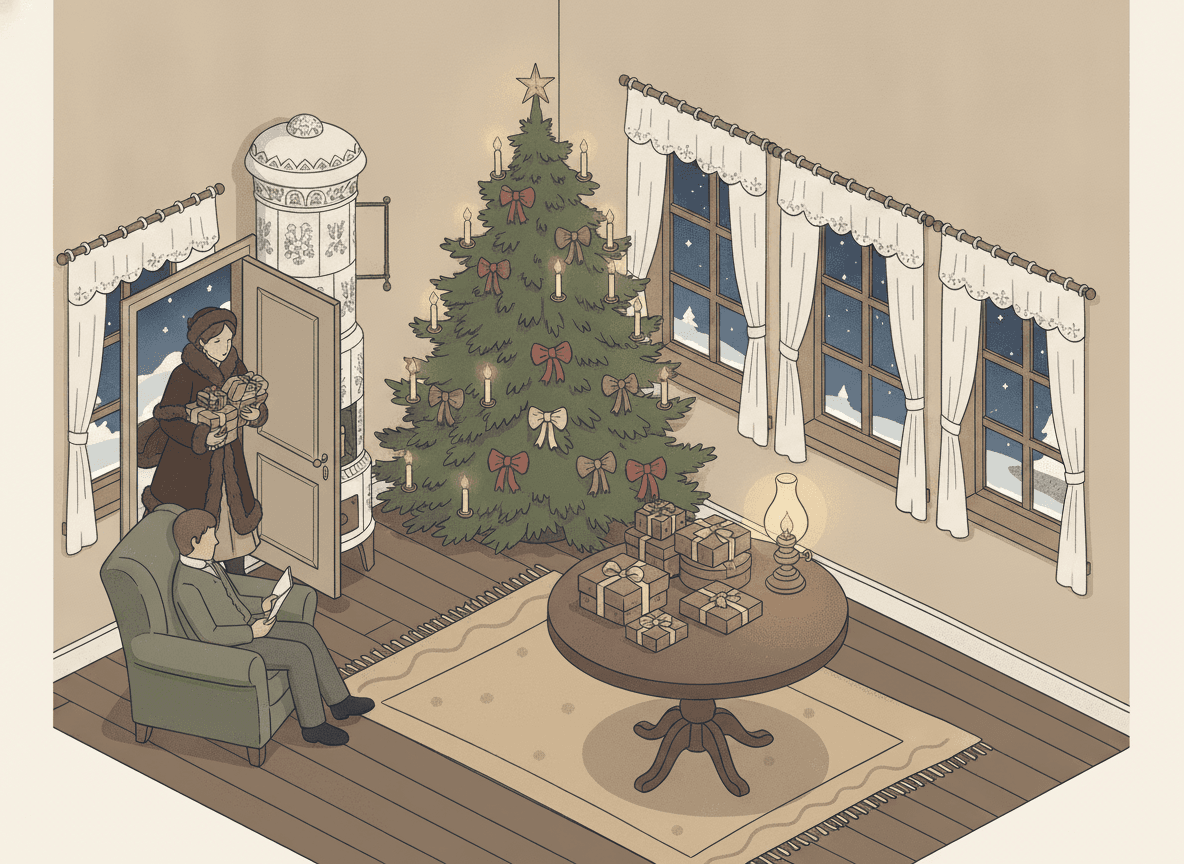
A Christmas in a comfortable Norwegian home, and the quiet lie holding it together.
How this book came to be
In 1879 Henrik Ibsen was a Norwegian writer living abroad, mostly in Rome and then Amalfi in Italy. He had left Norway years earlier, frustrated by its small, watchful society, and he wrote about it best from a distance. A Doll's House (Et dukkehjem) is a three-act play about Nora Helmer, a young wife who has secretly borrowed money to save her husband's life, and who slowly discovers what her comfortable marriage actually costs her.
The spark was real. Ibsen knew Laura Kieler, a young writer who had secretly taken out a loan to pay for a trip meant to restore her sick husband's health. When the debt came out, her husband turned on her and she was committed for a time to an asylum. Ibsen did not copy her life, but the situation stayed with him. His working notes from 1878 include the observation that a woman cannot be herself in a society that is a man's society, with laws written by men and judges who measure women by male standards.
The play was published in Copenhagen in December 1879 and sold out quickly, then went straight into new printings. It premiered at the Royal Theatre in Copenhagen a few weeks later. The ending caused an uproar, because Nora walks out of her house and shuts the door on her husband and children. Critics called it an attack on marriage itself. In Germany a leading actress refused to play the part as written, so Ibsen, rather than let someone else rewrite him, produced an alternative ending in which Nora stays. He called it a barbaric outrage and never disowned the original.
After that, the play kept moving. It reached London, then stages across Europe, Asia and the Americas, and it became one of the most performed plays in the world. It helped make modern drama a place for ordinary rooms and ordinary arguments rather than kings and heroes. UNESCO added Ibsen's own manuscript of the play to its Memory of the World register in 2001, partly because that final door has kept slamming for well over a century.
Continue in the app
Open the app for the illustrated story of this book and the world it was written in. The book itself is not included: it is still in copyright, so read it on Kindle or import your own EPUB into the app's library.
- ✓ The illustrated story of the book
- ✓ The world it was written in, on the map and timeline
- ✕ The full text is not included (in copyright)
Illustrations are created with AI assistance. Summaries are written with AI and reviewed by the editor. Book metadata comes from Wikidata and Open Library.