
Books ›
c. 1000 · Lejre
Beowulf
Monsters, mead-halls, and the oldest epic in English
How this book came to be
Beowulf is a long poem in Old English, about 3,182 lines, telling of a Geatish hero who fights a monster, the monster's mother, and, fifty years later, a dragon. Everything else about it is argued over.
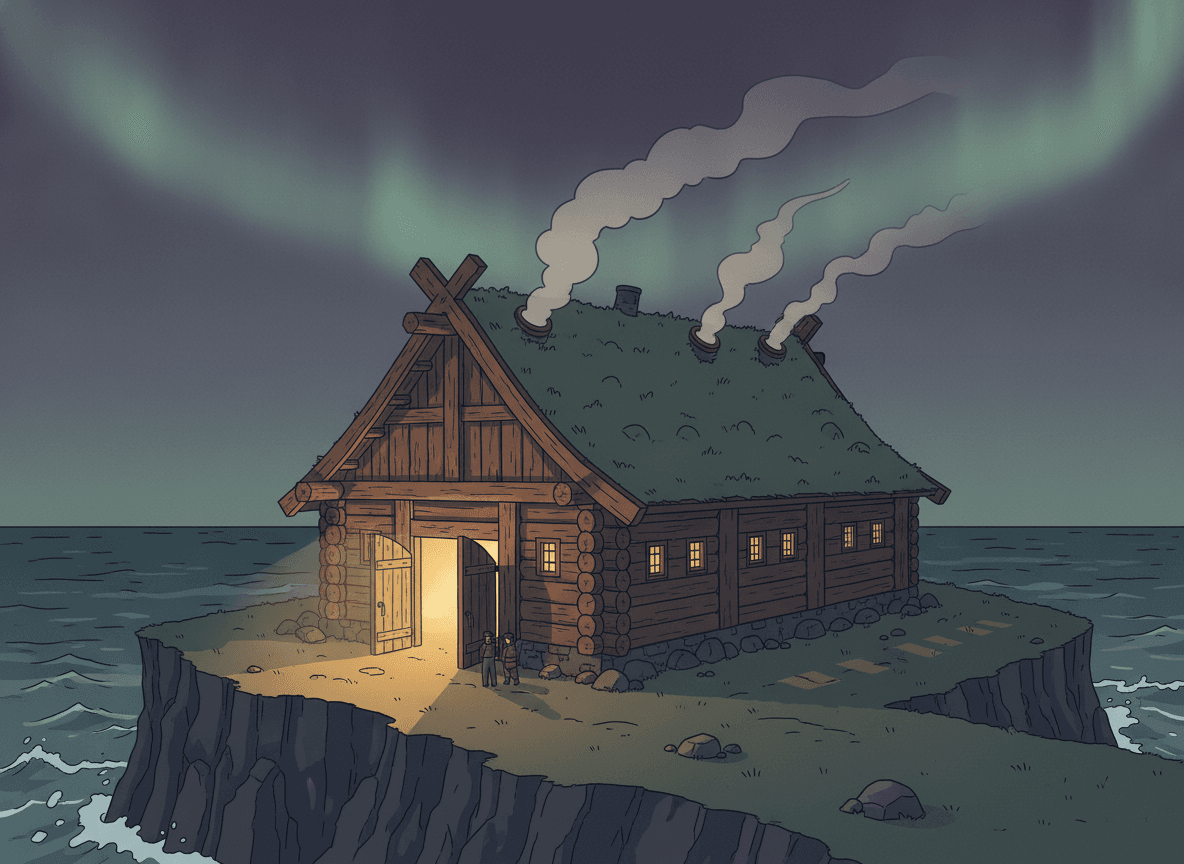
We do not know who made it. We do not know exactly when. The single surviving copy was written out by two scribes around the year 1000, in England, but the poem itself may be far older, carried for generations by singers before anyone set it in ink. Scholars have placed its composition anywhere from the 700s to the very decades of that manuscript. What is certain is the world it looks back to: Scandinavia, the Danes and the Geats, kings who bought loyalty with gold rings and mead-hall feasts. The poet was a Christian writing about pagan ancestors, and you can feel the strain. He admires their courage and mourns that they did not know his God.
The manuscript survived by luck and nearly did not. It sat in the library of Sir Robert Cotton, a seventeenth-century collector, and in 1731 a fire tore through that library at Ashburnham House. Beowulf was scorched along the edges. The pages kept crumbling afterward, which is why an Icelandic scholar's transcripts, made in 1787, now preserve words the burnt vellum has since lost.
For centuries nobody much cared. The poem was first printed in 1815 and read mainly as a quarry for historical scraps, monster fights and all. That changed in 1936, when J. R. R. Tolkien, an Oxford professor of Old English, gave a lecture arguing that the monsters were the point, not an embarrassment. He said the poem was about mortality, and about a man facing what he cannot beat. The argument won, and Beowulf became literature.
It has been translated hundreds of times since. Seamus Heaney, the Irish poet, made a version in 1999 that sold like a novel. Maria Dahvana Headley opened hers in 2020 with the word "Bro." Tolkien's own reading fed straight into Middle-earth, so the dragon on its hoard of gold reaches modern readers through Smaug as much as through the original.
Continue in the app
Open the app for the illustrated story of this book, the world it was written in, and the full text, a free public-domain edition, to read on screen or hear read aloud.
- ✓ The illustrated story of the book
- ✓ The world it was written in, on the map and timeline
- ✓ The full text, free, read or read aloud
Illustrations are created with AI assistance. Summaries are written with AI and reviewed by the editor. Book metadata comes from Wikidata and Open Library.