
Books ›
1823 to 1831 · Saint Petersburg
Eugene Onegin
A bored young man, a girl who dares to write first, and a shot that ruins them all.
How this book came to be
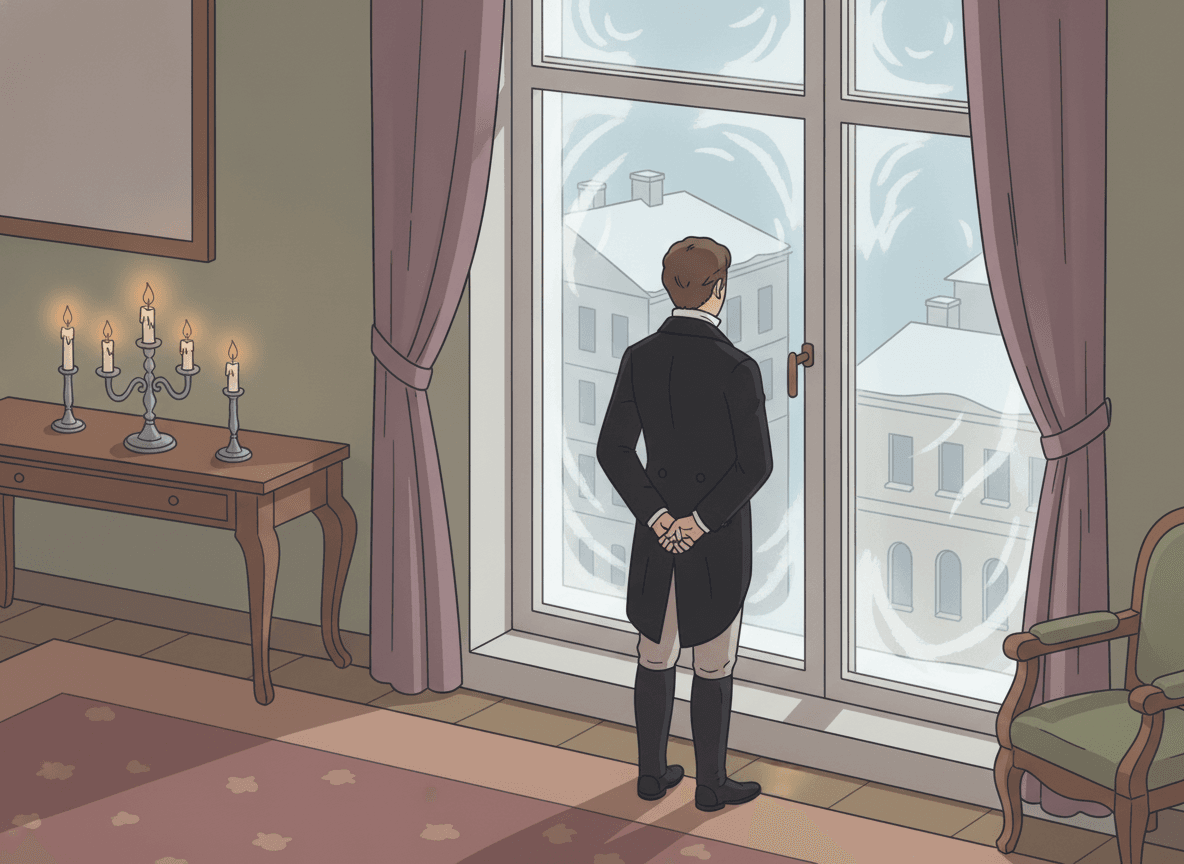
Eugene Onegin is a novel written entirely in verse, in fourteen-line stanzas so distinctive they are now called the Onegin stanza. It follows a bored young nobleman and the country girl who writes him a letter he answers badly.
Alexander Pushkin began it in 1823 in Kishinev, then Odessa, where the government had sent him. He was in official exile, punished for political poems that circulated in manuscript among young officers. In 1824 the authorities moved him again, this time to his mother's estate at Mikhailovskoye in the north, where he lived under the eye of the local police and the church. He wrote in a house with few visitors and long winters, and he kept working on the novel there.
The work took roughly eight years. He published it in pieces, chapter by chapter, starting in 1825, which meant readers followed it the way we follow a serial today. Each new chapter was an event. Because the chapters appeared over years, the book changed as Pushkin changed, and the mood of the later chapters is cooler and sadder than the first. Pushkin destroyed much of one chapter himself, and only fragments of the so-called Onegin's journey survive, so the novel we read has a visible gap in it.
The first complete edition came in 1833. Russian readers took it as something new, because Pushkin wrote about ordinary contemporary life in a language close to how educated Russians actually spoke. That choice helped settle modern literary Russian, which is why he is treated in Russia as the founder of the national literature.
Its afterlife is enormous. Pyotr Tchaikovsky, the composer, turned it into an opera in 1879, and that opera is still performed worldwide. The novel became a school text read by generations of Russian children, many of whom learn the heroine's letter by heart. Translators have fought over it for a century, most famously Vladimir Nabokov, whose deliberately unrhymed English version and vast commentary ended his friendship with the critic Edmund Wilson in a public quarrel. Pushkin himself died in 1837 after a duel, an ending readers have long compared, uneasily, to a duel inside his own book.
Continue in the app
Open the app for the illustrated story of this book and the world it was written in. The book itself is not included: it is still in copyright, so read it on Kindle or import your own EPUB into the app's library.
- ✓ The illustrated story of the book
- ✓ The world it was written in, on the map and timeline
- ✕ The full text is not included (in copyright)
Illustrations are created with AI assistance. Summaries are written with AI and reviewed by the editor. Book metadata comes from Wikidata and Open Library.