
Books ›
1899 · Congo River
Heart of Darkness
Joseph Conrad's voyage up a great river, into empire's lies and the shadows of the soul
How this book came to be
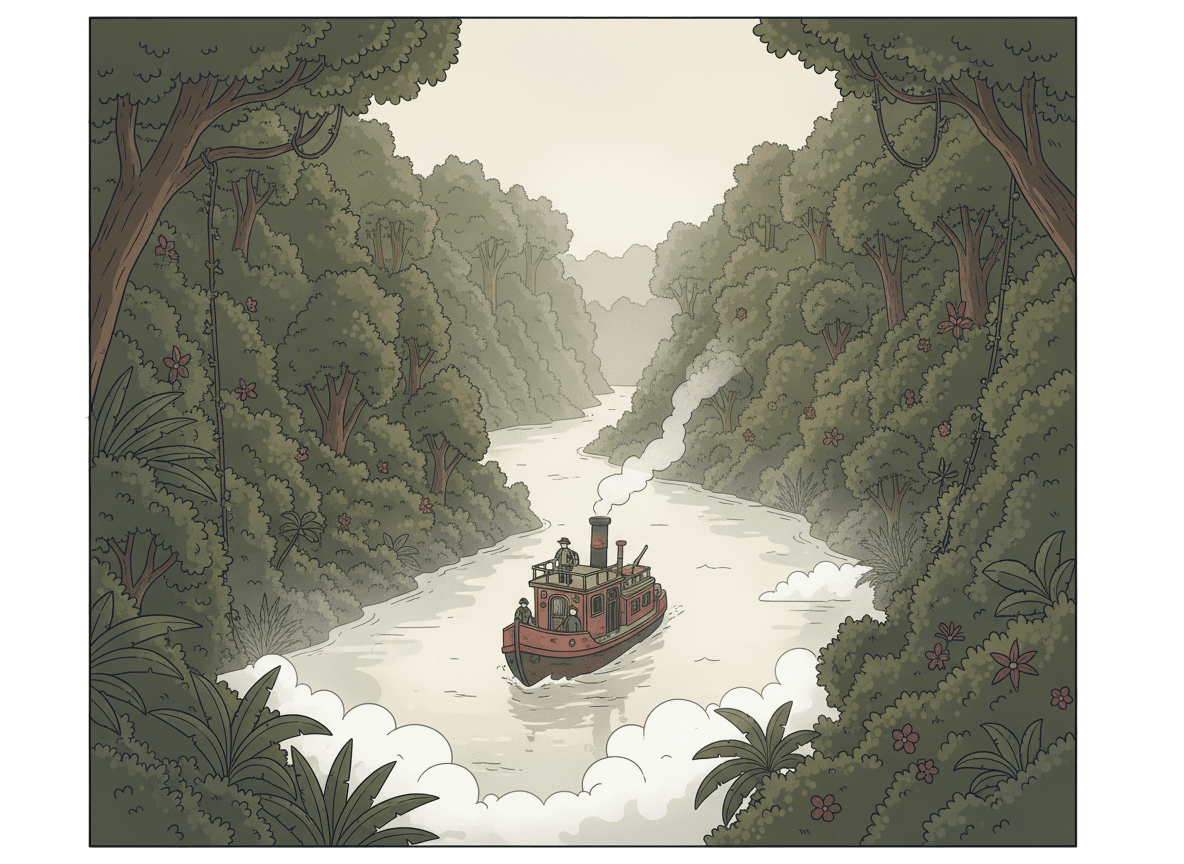
In 1890, a Polish sailor named Józef Teodor Konrad Korzeniowski signed on to command a river steamer in the Congo. He had been at sea for years, and he had wanted to see the great blank space on the map since he was a boy. What he found instead was the Congo Free State, a vast territory that King Leopold II of Belgium owned personally and ran for profit in ivory and, later, rubber. Conrad spent about six months there. He kept a small diary, saw men worked to death along the caravan road, and came home with dysentery and malaria that damaged his health for the rest of his life. He later said the Congo changed him completely.
Nine years passed before he turned it into fiction. By then he was Joseph Conrad, living in the English countryside in Kent, writing in his third language after Polish and French. He was chronically short of money and slow at the desk. He wrote the story quickly by his standards, through the winter of 1898 into early 1899, because Blackwood's Edinburgh Magazine wanted something for its thousandth issue. So the tale first reached readers in three monthly parts, February to April 1899, in a respectable Scottish magazine read by soldiers and colonial officers.
The form is a story told aloud. A sailor called Marlow sits on a boat anchored in the Thames at dusk and tells his friends about going upriver in Africa to find a company agent named Kurtz, a celebrated man who has come apart. That is the anchor; the book is really about what Marlow sees on the way.
It caused no scandal at first. It appeared in book form in 1902, bundled with two other stories. Its reputation grew slowly and then enormously. T. S. Eliot borrowed a line from it as the epigraph to a poem. Francis Ford Coppola moved it to Vietnam and made Apocalypse Now in 1979. And in 1975 the Nigerian novelist Chinua Achebe attacked it in a famous lecture, arguing that Conrad reduced Africans to scenery for a European crisis of conscience. That argument never ended, which is one reason the book is still read and still fought over.
Continue in the app
Open the app for the illustrated story of this book, the world it was written in, and the full text, a free public-domain edition, to read on screen or hear read aloud.
- ✓ The illustrated story of the book
- ✓ The world it was written in, on the map and timeline
- ✓ The full text, free, read or read aloud
Illustrations are created with AI assistance. Summaries are written with AI and reviewed by the editor. Book metadata comes from Wikidata and Open Library.