
Books ›
1847 · Derbyshire
Jane Eyre
A plain governess who refused to be small, and the house on the moor that kept a secret.
How this book came to be
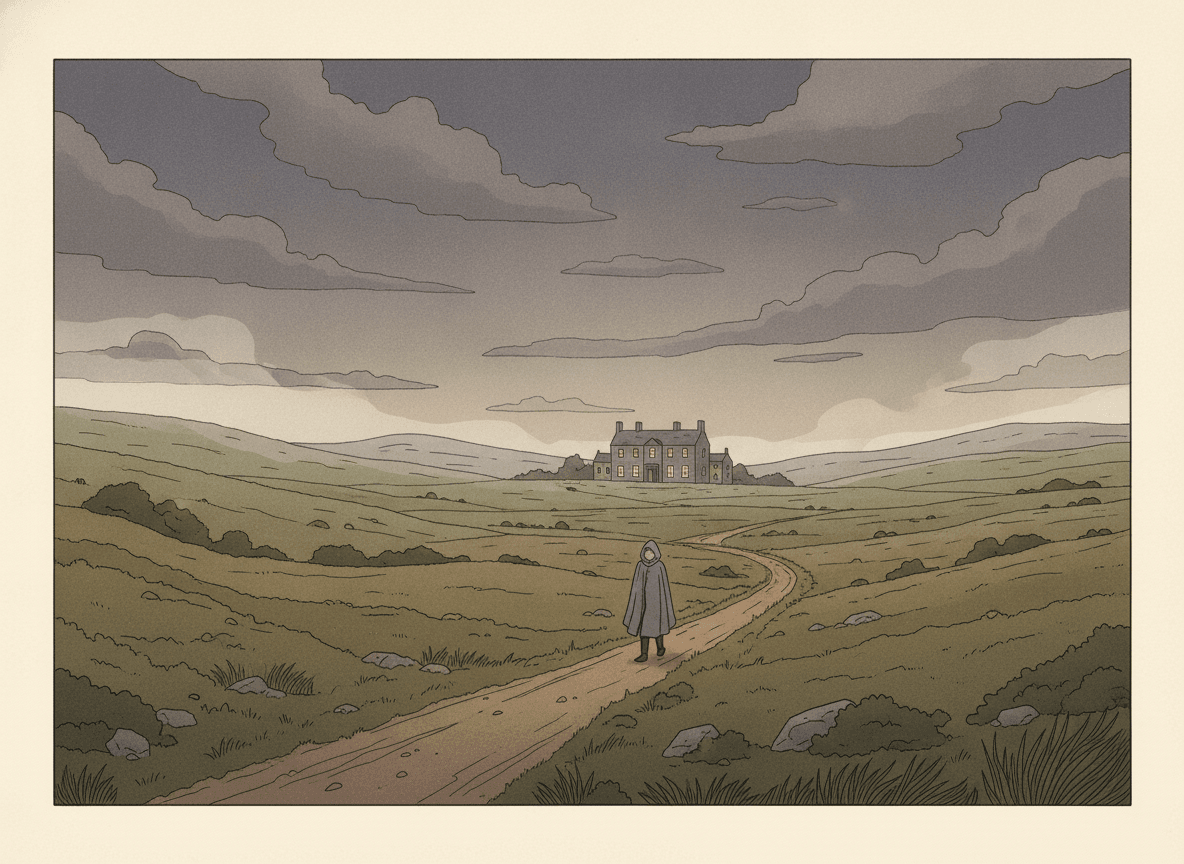
In 1846, three sisters in a stone parsonage on the Yorkshire moors were writing in secret. Charlotte Brontë was the eldest surviving of them. She had worked as a governess and hated it, because a governess in a wealthy house was neither family nor servant, and was often treated as furniture that could read. She had also spent months in Brussels studying and teaching, and had fallen painfully in love with her married tutor. He did not answer her letters. That silence sits somewhere under everything she wrote next.
Her first novel, The Professor, was rejected again and again. One publisher, Smith, Elder & Co., turned it down but added a kind note saying they would look at a longer book. Charlotte already had one growing. She wrote Jane Eyre fast, finishing in about a year, partly at her father's bedside in Manchester while he recovered from eye surgery in a darkened room.
The novel is the life story of a plain, poor, fiercely independent orphan who becomes a governess and falls in love with her employer. What startled readers was the voice. Jane narrates in first person, argues with her superiors, and insists she has a soul equal to anyone's. Nothing in English fiction had quite spoken like that.
Smith, Elder published it in October 1847, six weeks after receiving the manuscript. It sold immediately. The author's name on the title page was Currer Bell, a deliberately ambiguous pen name the sisters used so their work would be judged on its own. Thackeray, the era's leading novelist, stayed up all night reading it. Others were appalled, calling the book coarse and anti-Christian, because Jane's anger at cruel adults and hypocritical clergy was read as rebellion against the whole social order. When Charlotte's identity emerged, London literary society was astonished that this had come from a clergyman's daughter in a remote village.
Charlotte outlived all her siblings and died in 1855, aged 38. Her novel never went out of print. It shaped the shape of the modern first-person novel, and it keeps generating answers: Jean Rhys's Wide Sargasso Sea (1966) retells the story from the point of view of the woman locked in the attic, turning Brontë's gothic device into a study of empire and madness.
Continue in the app
Open the app for the illustrated story of this book, the world it was written in, and the full text, a free public-domain edition, to read on screen or hear read aloud.
- ✓ The illustrated story of the book
- ✓ The world it was written in, on the map and timeline
- ✓ The full text, free, read or read aloud
Illustrations are created with AI assistance. Summaries are written with AI and reviewed by the editor. Book metadata comes from Wikidata and Open Library.