
Books ›
1949 · London
Nineteen Eighty-Four
A clerk in a watched city decides that two plus two makes four.
How this book came to be
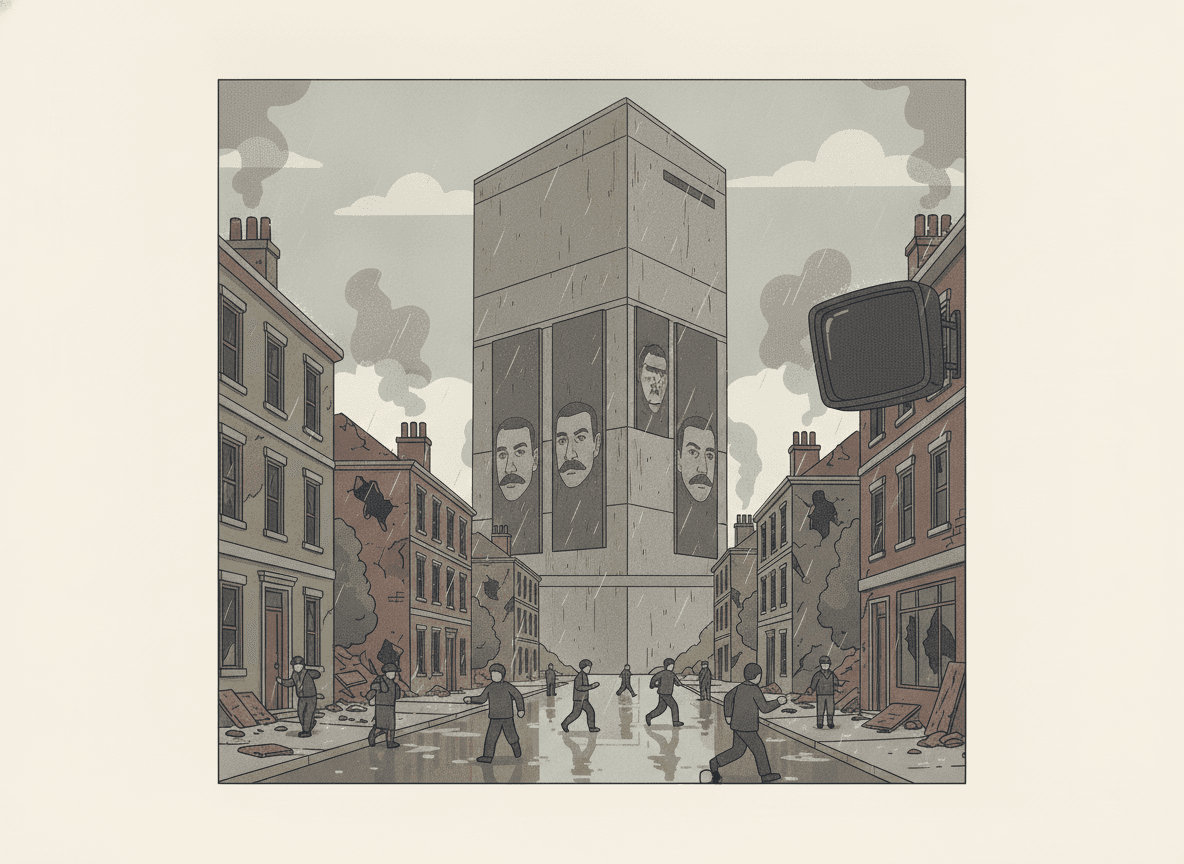
George Orwell wrote Nineteen Eighty-Four while he was dying. In 1946 he moved to Jura, a remote island off the Scottish coast, into a farmhouse called Barnhill with no telephone and no easy road out. His wife Eileen had died in 1945, and he was raising their adopted son alone with help from his sister. Tuberculosis was eating through his lungs. He typed much of the final manuscript himself, propped up in bed, because he could not find a typist willing to come that far north.
The book is a novel about a man in a future London who works for a government that rewrites the past and watches everyone all the time. Orwell had spent years thinking about how power lies. He had fought in the Spanish Civil War and watched newspapers report battles that never happened. During the Second World War he worked for the BBC, writing propaganda he found uncomfortable, and he studied how Stalin's Soviet Union erased people from photographs and from history books.
It came out in June 1949, in London and New York, and sold fast. Reviewers argued at once about what it meant. Some read it as an attack on socialism itself, which annoyed Orwell, because he was a socialist and said so. He issued a statement explaining that the book was a warning about what any system could become, not a prediction. He died seven months later, in January 1950, aged 46.
Its afterlife is enormous. The Soviet Union banned it for decades. It became a set text in schools across the English-speaking world and was filmed, staged and adapted many times. More striking is what happened to its vocabulary. Big Brother, thoughtcrime, doublethink, Room 101 and Newspeak all left the novel and entered ordinary English. People who have never read a page use them to argue about surveillance, propaganda and official lying. Sales spike whenever a government is caught watching its citizens, which has happened often enough to keep the book permanently in print.
Continue in the app
Open the app for the illustrated story of this book and the world it was written in. The book itself is not included: it is still in copyright, so read it on Kindle or import your own EPUB into the app's library.
- ✓ The illustrated story of the book
- ✓ The world it was written in, on the map and timeline
- ✕ The full text is not included (in copyright)
Illustrations are created with AI assistance. Summaries are written with AI and reviewed by the editor. Book metadata comes from Wikidata and Open Library.