
Books ›
1572 · Kozhikode
Os Lusíadas
Camões and his salt-sprayed epic of Vasco da Gama, jealous gods, and Portugal's leap into the unknown
How this book came to be
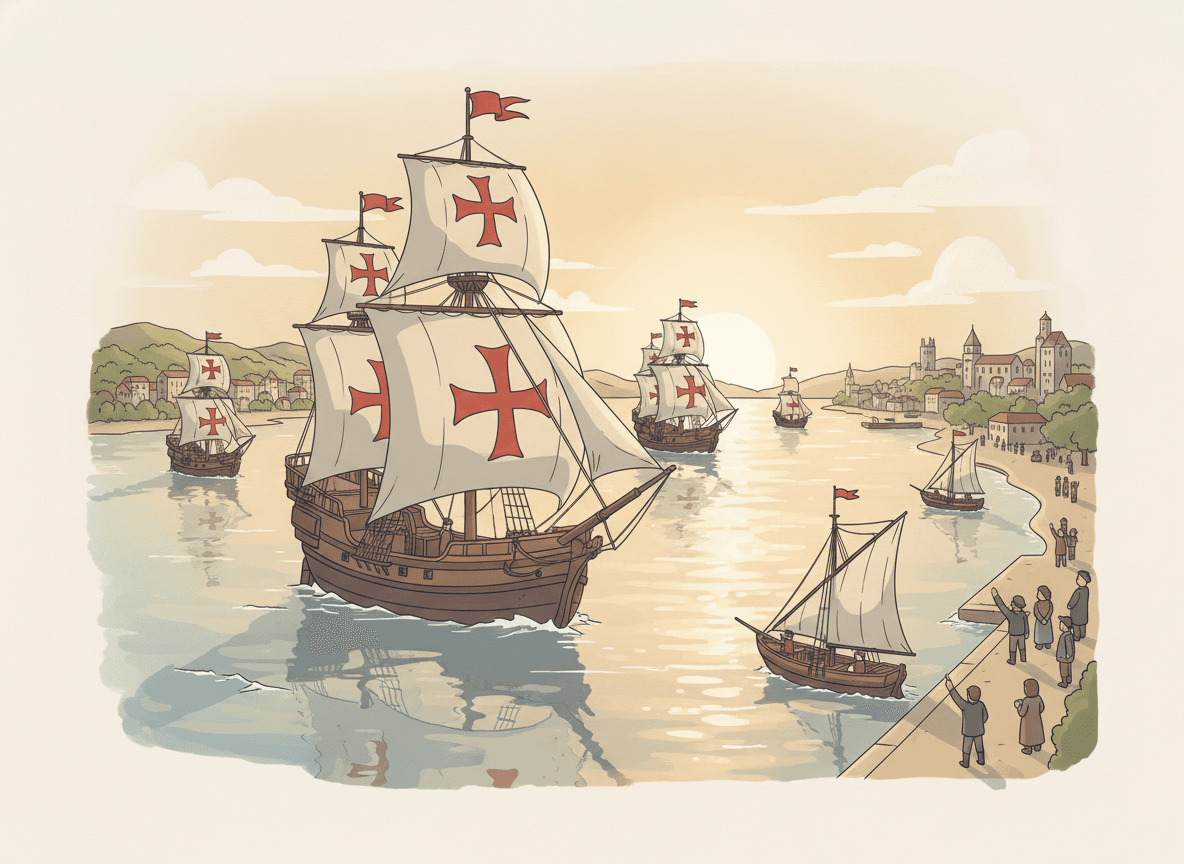
Os Lusíadas is an epic poem in ten cantos, published in Lisbon in 1572. Its subject is the sea voyage of Vasco da Gama, the Portuguese captain who sailed around Africa to India in 1497 and 1498. Around that voyage the poem gathers the whole story of Portugal, with the gods of ancient myth arguing overhead about whether the sailors should live or drown.
The man who wrote it, Luís de Camões, knew the empire from its rough edges rather than from a court library. He was a minor nobleman with an unsteady temper and no money. He lost the sight in his right eye fighting in North Africa. Back in Lisbon he was jailed after a street brawl, and he seems to have won release by agreeing to sail east as a soldier. So he spent roughly seventeen years in Portuguese Asia: Goa, then Africa's east coast, then Macau. He was poor almost the whole time, and he worked on the poem as he went.
A famous story says he was shipwrecked near the mouth of the Mekong and swam ashore holding the manuscript above the water. It is a tradition rather than a documented fact, and historians treat it with caution. What is certain is that he came home in 1570 with a finished poem and almost nothing else.
He dedicated it to Sebastião, the teenage king of Portugal, and the censors of the Inquisition let it through. The king granted him a small pension, paid irregularly. Camões died in 1580, poor, in the same year Spain took the Portuguese crown. The timing gave the poem a second life at once: as Portugal lost its independence, readers held on to the book that told them who they had been.
It became the national epic. Portuguese is still called the language of Camões. His invented sea giant, Adamastor, who rises out of the storm at the Cape of Good Hope to curse the sailors, entered European literature as one of its great images of a continent refusing to be rounded. The poem has been translated into dozens of languages since the first English version in 1655. Portugal's national day falls on 10 June, the date of his death.
Continue in the app
Open the app for the illustrated story of this book and the world it was written in. The book itself is not included: it is still in copyright, so read it on Kindle or import your own EPUB into the app's library.
- ✓ The illustrated story of the book
- ✓ The world it was written in, on the map and timeline
- ✕ The full text is not included (in copyright)
Illustrations are created with AI assistance. Summaries are written with AI and reviewed by the editor. Book metadata comes from Wikidata and Open Library.