
Books ›
c. 1353 · Florence
The Decameron
Ten storytellers, one hundred tales, and life defying the plague
How this book came to be
In 1348 the plague reached Florence, and by some estimates it killed more than half the city. Giovanni Boccaccio, a merchant's son in his mid-thirties, lived through it. He had grown up partly in Naples, where his father worked for the Bardi banking house, and he had been trained for business and law before turning to writing. The plague took people close to him, very likely his father among them. Out of that wreckage came the Decameron, finished around 1353.
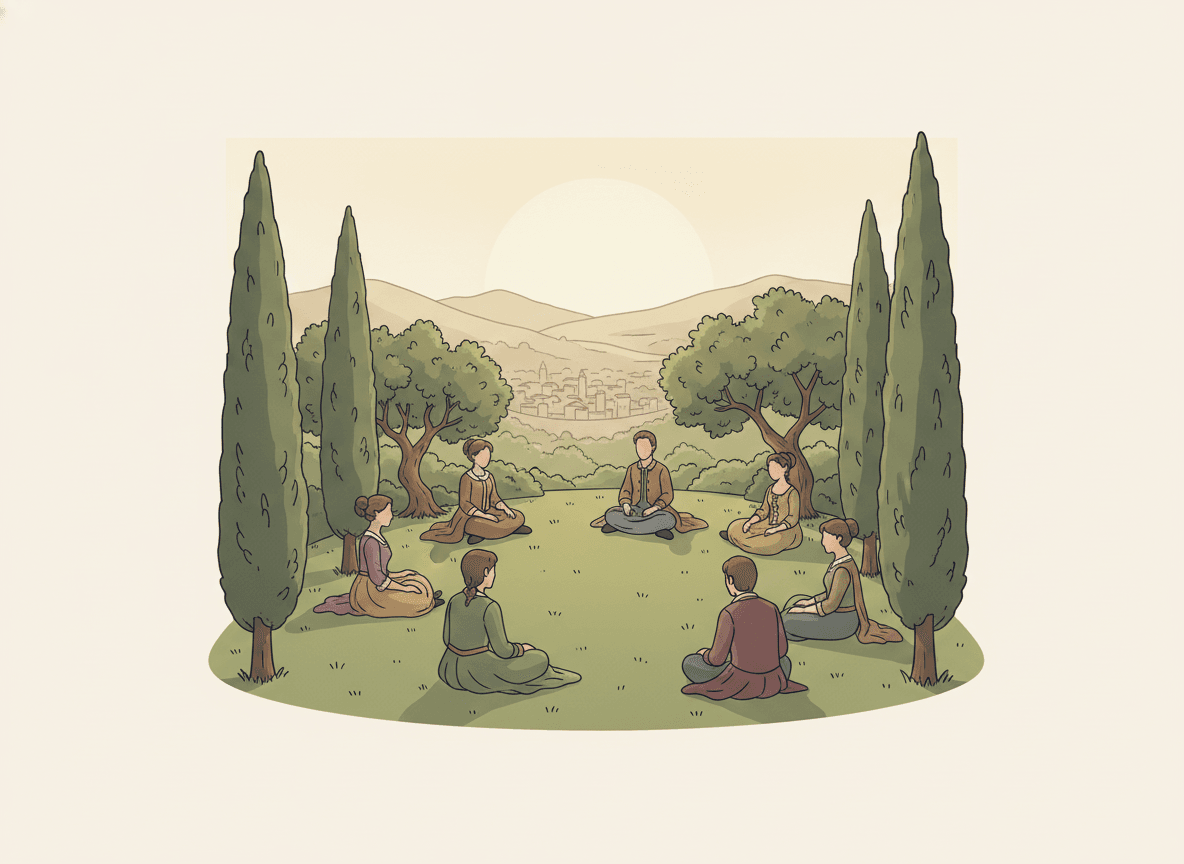
It is a book of one hundred short tales held inside a frame story. Seven young women and three young men meet in a Florentine church, agree that staying means dying, and ride out to villas in the hills. To keep despair at bay, they tell each other stories, ten a day. The telling fills ten days, spread over about a fortnight, because they pause for prayer and chores. That is where the title comes from: Greek for "ten days".
The tales themselves are nothing like sermons. Merchants cheat, lovers scheme, clever wives outwit jealous husbands, and a few friars come off very badly. Boccaccio wrote them in the Florentine vernacular rather than Latin, which meant ordinary literate people could read them, not just scholars. He said in his preface that he wrote for women in love, who had fewer distractions than men and more time to suffer.
Readers took to it fast. Handwritten copies spread through Italy within Boccaccio's lifetime, and one surviving manuscript in Berlin, known as Hamilton 90, is widely thought to be in his own hand. Printing multiplied it further. Then the Counter-Reformation caught up: the Church put the book on its index of banned works, and an official cleaned-up version appeared in 1573, with the corrupt priests quietly turned into laymen.
Its reach outran the censors. Geoffrey Chaucer, the English poet, borrowed from Boccaccio for the Canterbury Tales, which uses the same trick of travellers swapping stories. Later writers kept raiding it for plots, Shakespeare included. And the frame itself has proved oddly durable, because the idea of people locked away from a plague telling stories to stay sane keeps finding new readers who recognise the situation.
Continue in the app
Open the app for the illustrated story of this book, the world it was written in, and the full text, a free public-domain edition, to read on screen or hear read aloud.
- ✓ The illustrated story of the book
- ✓ The world it was written in, on the map and timeline
- ✓ The full text, free, read or read aloud
Illustrations are created with AI assistance. Summaries are written with AI and reviewed by the editor. Book metadata comes from Wikidata and Open Library.