
Books ›
1943 · Sahara Desert
The Little Prince
A pilot, a desert, and a child who fell from the stars
How this book came to be
At the very end of 1940, Antoine de Saint-Exupéry arrived in New York as an exile. France had fallen to Germany, and he had flown reconnaissance missions before the collapse. He spoke almost no English, so the city stayed slightly foreign to him. He was also in pain: an old crash had left his body damaged, and he quarrelled bitterly with other French exiles about how to resist. He wanted to fly again, and could not.
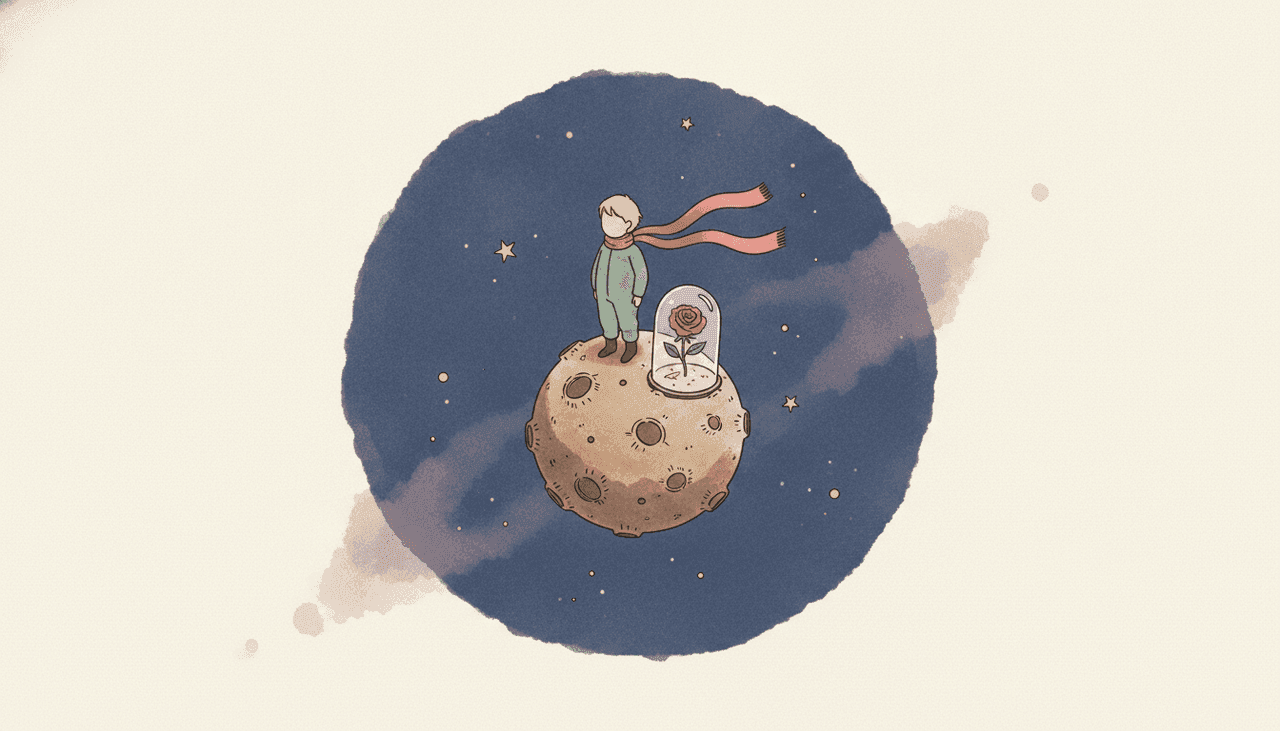
He had been drawing the same small figure for years, a little boy with a scarf, in the margins of letters and on restaurant tablecloths. The story goes that his American publishers, Curtice Hitchcock and Eugene Reynal, saw the doodles and suggested he make a children's book out of him. Saint-Exupéry wrote through the summer of 1942, largely on Long Island and in a Manhattan apartment, working at night, and he painted the watercolours himself.
The result was a short book about a pilot stranded in the Sahara who meets a boy from a tiny asteroid. Saint-Exupéry knew that desert firsthand, because in 1935 he crashed in Libya and nearly died of thirst before a Bedouin traveller found him.
Le Petit Prince appeared in New York in April 1943, in French and in English, because occupied France could not publish it. Sales were modest at first. Saint-Exupéry did not see its success. He talked his way back into a reconnaissance squadron and, on 31 July 1944, took off from Corsica and never returned. His plane's wreck was only identified off Marseille in 2004.
France finally read the book in 1946, after the war. From there it travelled astonishingly far. It has been translated into more than 500 languages and dialects, which makes it one of the most translated books ever written, and it has sold in the tens of millions. Its fox and its rose have become shorthand for how love works: you become responsible for what you tame. The prince himself is a rare thing, a character invented in the twentieth century who now feels as old and as portable as a folk tale.
Continue in the app
Open the app for the illustrated story of this book and the world it was written in. The book itself is not included: it is still in copyright, so read it on Kindle or import your own EPUB into the app's library.
- ✓ The illustrated story of the book
- ✓ The world it was written in, on the map and timeline
- ✕ The full text is not included (in copyright)
Illustrations are created with AI assistance. Summaries are written with AI and reviewed by the editor. Book metadata comes from Wikidata and Open Library.