
Books ›
1942 · Algiers
The Stranger
A man who will not pretend, and the sun that undoes him.
How this book came to be
Albert Camus was twenty-six and broke when he finished L'Étranger. He had grown up poor in Algiers, raised by a mother who cleaned houses and barely spoke, and by a grandmother who ruled the household. Tuberculosis had already ended his hopes of a teaching career and of playing goalkeeper. He worked instead as a journalist, writing about poverty and injustice in colonial Algeria, until his paper was shut down and he was effectively pushed out of the country.
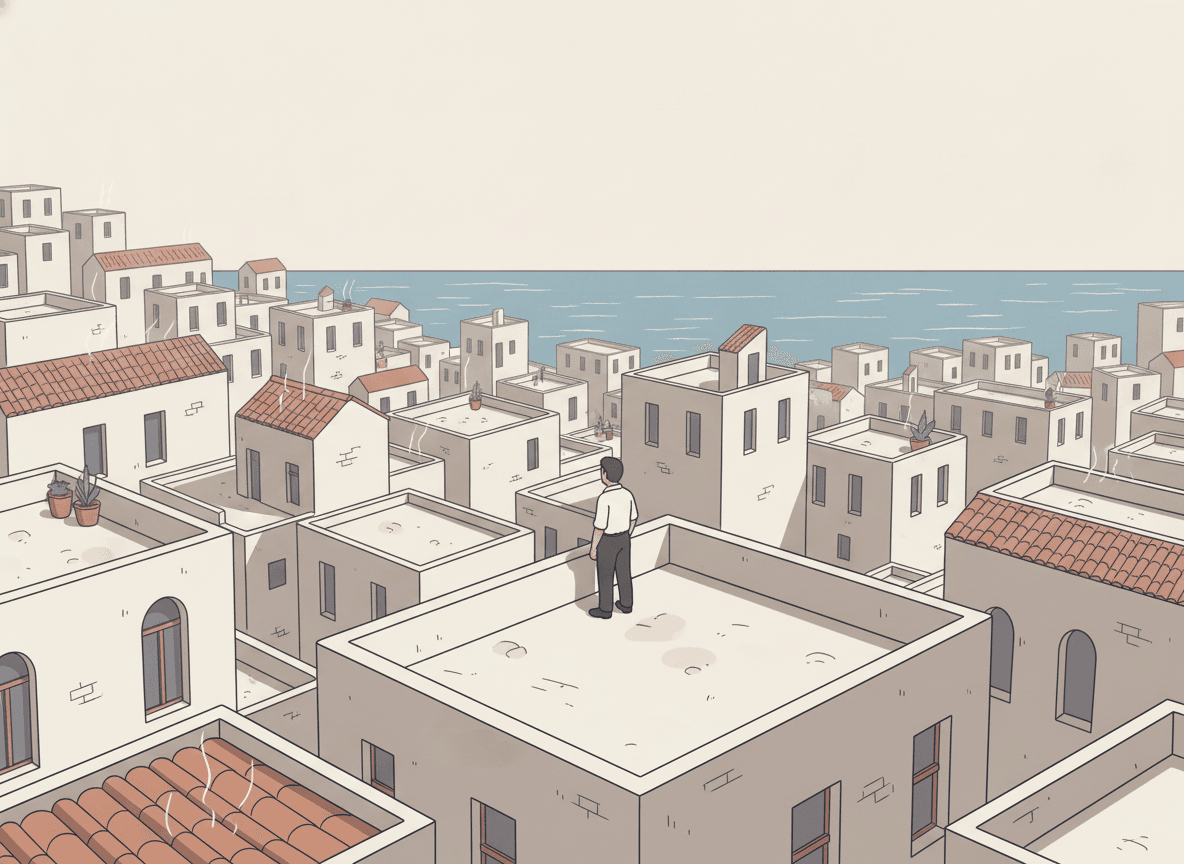
He carried the manuscript to France. In May 1940, in a hotel room in Paris, he wrote in his notebook that the book was finished. German troops entered the city weeks later. The novel is short, told in flat first person by Meursault, a French Algerian clerk who does not cry at his mother's funeral and who later kills a man on a beach. The court that tries him seems less interested in the killing than in his failure to grieve properly. That was Camus's real subject: a society that punishes people for not performing the feelings it expects.
Getting it printed took work. The writer André Malraux read the manuscript and pushed for it, and Gallimard published it in June 1942, while France was under German occupation. The censors let it through, because they saw nothing political in it. Paper was scarce, so the first run was small. Readers found it anyway. Jean-Paul Sartre, the philosopher, wrote a long analysis of it in 1943 that helped fix the book at the center of French thinking about the absurd, the idea that we crave meaning from a universe that offers none.
Camus won the Nobel Prize in 1957 and died in a car crash in 1960, at forty-six. His novel kept going. It became one of the most assigned books in French schools and, in translation, in schools worldwide. Its first sentence is famous enough to be argued over by translators. In 2013 the Algerian writer Kamel Daoud answered it with The Meursault Investigation, which gives a name and a family to the Arab man Camus left nameless. Seventy years on, the book was still provoking replies.
Continue in the app
Open the app for the illustrated story of this book and the world it was written in. The book itself is not included: it is still in copyright, so read it on Kindle or import your own EPUB into the app's library.
- ✓ The illustrated story of the book
- ✓ The world it was written in, on the map and timeline
- ✕ The full text is not included (in copyright)
Illustrations are created with AI assistance. Summaries are written with AI and reviewed by the editor. Book metadata comes from Wikidata and Open Library.